The global nuclear power industry will increase its capacity by three-quarters in the coming decades, according to an industry report prepared by the Nuclear Association. If you don’t quickly start developing new mines, there will be a shortage on the market very quickly.
On Thursday, the World Nuclear Association, in its first market report since 2021, said there were 391 gigawatts of nuclear power plants worldwide, meeting a tenth of global electricity demand. According to the forecast, by 2040 this figure will increase to 686, and possibly to 931 gigawatts.
At an event in London, industry executives said the accompanying rise in fuel demand would lead to a reduction in uranium supplies. After the disaster at the Fukushima nuclear power plant in Japan in 2011, which led to the closure of dozens of reactors, the uranium market was dormant for ten years. Mining companies have cut production due to low prices.
However, Japan has recently restarted reactors, and new reactors have come online in the US, Europe and Asia. The Inflation Reduction Act has prompted US utilities to extend the life of existing reactors.
Miners and other companies in the complex nuclear fuel supply chain are scrambling to ramp up production to meet increased demand, traders said. As a result, uranium prices in recent days have reached near their highest levels in a decade.
Shares of uranium miners, including New York-listed Uranium Energy and Toronto-listed Denison Mines, are rising strongly. So are shares of the Sprott Physical Uranium Trust, a Toronto-based fund that buys a physical form of uranium called “yellow cake,” allowing investors to profit from rising prices.
“Intensive development of new projects will be required in the current decade to avoid possible future supply disruptions,” the WNA report said. Once discovered, uranium extraction takes eight to 15 years.
“Approval is inevitable. The dichotomy between futures and cash products cannot go on forever,” he said.
Clayton said he was not surprised by the agency’s decision to delay consideration of applications for the launch of spot bitcoin ETFs from BlackRock, Fidelity, Bitwise, VanEck, WisdomTree, Invesco and Valkyrie until mid-autumn.
At the same time, he also declined to answer the question of how he would have acted in the place of the current chairman of the Commission, Gary Gensler.
“It is clear that bitcoin is not a security. It is clear to all that retail and institutional investors want access to it. And more importantly, some of our most trusted vendors want to provide bitcoin to the retail public,” he added.
On June 15, BlackRock filed an application with the SEC for an investment product based on digital gold. Following the financial giant, similar requests came from Valkyrie, Fidelity Investments, WisdomTree and Invesco. However, the regulator returned all applications.
Debt ceiling dispute pushes U.S. credit default swaps to 12-year peak
The cost of insuring the sovereign debt of the United States rose on Thursday to its highest level since 2011 due to market fears that the government may reach the national debt ceiling earlier than expected.
US five-year credit default swap spreads widened to 49 basis points, data from S&P Global Market Intelligence showed. This is more than double the level at which they were in January this year.
The White House has accused Republicans in the House of Representatives of “holding the American economy hostage” with its proposal to tie the debt ceiling hike to budget cuts, which has intensified divisions between President Joe Biden and lawmakers as the deadline approaches.
“MAGA House Republicans are holding the American economy hostage to strike at the programs Americans rely on every day to make ends meet,” White House press secretary Karine Jean-Pierre said Thursday, using an acronym for the former president’s slogan. Donald Trump “Make America Great Again”
House Speaker Kevin McCarthy on Wednesday unveiled a plan that would cut $130 billion in discretionary spending and raise the US debt ceiling by $1.5 trillion.
He called for the repeal of last year’s climate and health bill, known as the Inflation Reduction Act, and the repeal of Biden’s legally troubled plan to ease student debt.
“Every Republican in the House of Representatives who votes for this bill is voting to cut education, veterans’ health care, cancer research, food on wheels, food safety, and law enforcement,” Jean-Pierre added. “Taking healthcare away from millions of Americans and jeopardizing food assistance for hundreds of thousands of older people. Raise electricity bills and raise taxes for hard-working families.”
The Republicans refused to increase the US national debt without serious concessions, and Biden called this demand non-negotiable. Even if McCarthy’s proposal were approved by the House of Representatives, the Democratic-controlled Senate would refuse to consider it.
Analysts at Goldman Sachs Group Inc. on Tuesday they warned that due to lower tax revenues, the US default date could be closer to June rather than August, as some economists predicted.
Treasury Secretary Janet Yellen set a deadline earlier this year for “extraordinary measures” to temporarily avoid a default.
McCarthy has promised more conservative members of the House’s narrow Republican majority that he will demand massive spending cuts as part of any deal to raise the debt ceiling.
Almost at the same time that McCarthy detailed his proposal on the floor of the House of Representatives, Biden gave a speech at a union plant in Maryland denouncing Republicans’ attempts to make debt cap increases contingent on federal spending negotiations. According to him, these two issues should be separated.
– The risk-reward ratio is a coefficient designed to calculate the potential profitability of a trading transaction relative to the inherent risk and taking into account the trader’s strategy. RR will allow you to understand whether the transaction is profitable or not.
– The risk/reward ratio is calculated after drawing up a trading plan, determining entry and exit points, and setting a stop loss level.
– The risk/reward ratio is calculated individually for each position based on the trader’s trading strategy, taking into account statistics and opportunities.
– A good risk-to-reward ratio allows you to earn in the long run with a correct analysis of the results of your trading strategy.
What is Risk Reward Ratio (RR)
The ratio of risk and profit (Risk / Reward Ratio or RR) – a ratio showing the ratio of risk to potential profit. A specific RR value is calculated before buying an asset and allows you to assess the potential of the transaction in terms of the trader’s trading strategy.
If the risk to reward ratio is greater than 1, then the risk is greater than the potential reward. When the value is below one, then the potential profit is greater than the inherent risks.
In terms of trading and investing, risk refers to the potential loss that a trader is willing to take when opening a position. The level of risk is usually controlled by placing Stop Loss orders, that is, applications for the automatic sale of an asset when a certain price is reached. This is an important trading tool, and it is necessary not only to limit losses. The level of risk is an integral part in the process of calculating the potential profit of a trader and his trading strategy as a whole.
Profit is the difference between the purchase price of an asset and the price at which it will be sold. In the context of the RR ratio, profit is the potential level that a trader determines before entering a position to assess the potential of a trade operation.
How to correctly calculate the risk-to-reward ratio
The generally accepted version of the calculation of the RR ratio is defined as the ratio of risk to reward, that is, RR equal to risk divided by profit. Although some traders, due to personal preference, may use the reverse option, where profit is divided by risk, we will consider a standard calculation example, according to the formula below:
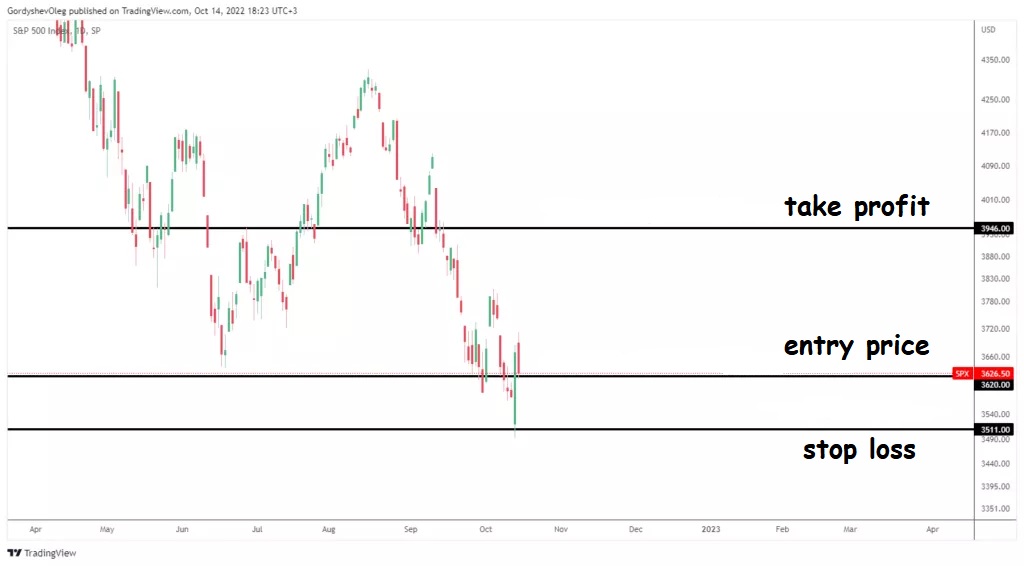
For example, that you want to buy an asset at a price of $100. You also decided to limit your risk, that is, put a stop loss at $90, and set a target price for yourself to sell the asset at $130. In this case, the ratio of RR will be 1 to 3, or a coefficient with an approximate value of 0.33. That is, the risk is less than the potential profit.
In the example with the same entry price ($100) and the same target price ($130) but with a stop loss of $40, the RR ratio would be 2. This ratio would indicate that the risk significantly exceeds the expected reward.
Optimum risk/reward ratio
One of the most popular values when calculating the ratio of risk and reward is 1 to 3 or a ratio of 0.33. Ratios of 1 to 7, 1 to 10, 1 to 15 are also often used.
However, the choice of generally accepted RR options is a gross mistake in trading. The trader himself must determine which RR ratio is best suited for his trading strategy based on experimental data, statistics, and market conditions.
For example, if a trader makes only 50% of successful trades, then RR equal to 0.5 or 1 to 2 will not bring any benefit. The target selling price of an asset before entering a trade should statistically bring profit to the trader, and not just specifically in this trade operation.
In the example with a ratio of 1 to 3 or a ratio of 0.33, the meaning of RR is that one profitable trade can cover 3 losing trades. In the case when the ratio is 1 to 5, then one profitable transaction will have to cover 5 unprofitable ones.
An example of a trading position on the S&P 500 chart with a risk to reward ratio of 1 to 3.
Before assessing risks and making RR calculations, a trader evaluates the potential for price movement, finds an entry point and makes a forecast for the movement of the price of an asset, also determining the moment for exiting a position.
Only then does it make sense to calculate RR. If the resulting coefficient corresponds to the trader’s trading strategy, then he enters the position.
Why Calculate Risk Reward Ratio
RR is calculated so that the trader can effectively use his trading strategy, adjusting the desired level of risk and profit to generate income over a long period of time.
Even if the percentage of successful trades is small, say 20%, then a competent risk-reward ratio can bring a trader income in the long run.
Conclusion:
What is the reward to risk ratio?
The Risk/Reward Ratio or RR is a way of assessing the potential of a trade for a trader based on their trading strategy and capabilities. Simply put, RR shows whether a trade is profitable or not based on potential risk and reward.
What is win rate in trading?
Win rate in trading is the ratio of the number of profitable trades to losing trades. For example, if you close 60% of trades with a profit and 40% with a loss, then your win rate will be 0.6 to 0.4, or 1.5.
What is 1 to 3 in trading?
1 to 3 in trading is one of the most popular reward to risk ratios among traders. It means that at least 1 out of 4 trades must be profitable. However, this ratio should be consistent with the chosen trading strategy and correlated with the win rate. In some cases, the optimal ratio of profitable trades to losing trades may differ.
What is RR in trading?
RR in trading is an abbreviation of the English term Risk / Reward (Risk / profitability) and means the ratio of profit to risk.
The word trading comes from the verb “trade” and means making transactions with securities, goods or currencies in order to make a profit.
Traders are called participants in exchange trading, earning on exchange rate differences.
Investors are those who are aimed at obtaining benefits in the future by investing (investing) financial resources.
A broker is a company that provides individuals and legal entities with access to stock exchanges.
A personal advisor is often an employee of a broker or other financial institution. He does analytical work for the client and can give investment advice or develop a complete investment strategy.
Trading types
Depending on the strategy used and the duration of transactions, trading is conditionally divided into several types.
High frequency. All operations are performed by a computational algorithm. In accordance with a given program, he places a lot of orders – orders for buying and selling (from the English high-frequency trading, HFT). All transactions are carried out in seconds or even faster. It follows that a high-frequency trader must have knowledge of trading algorithms and programming skills. In addition, such a strategy is very risky. It requires high material costs for appropriate equipment and provision of dedicated Internet access. A good communication channel is a prerequisite to avoid any time delays during the trading session. This trading strategy is not suitable for beginners.
scalping. Transactions, as in high-frequency trading, are carried out for short periods of time, but last longer – from several seconds to several minutes. Scalping is also based on a certain strategy, according to which a trader filters out securities with the required volatility (trading volume) and other specified parameters. The purpose of transactions is to withdraw a small profit in each trade. Day trading. As the name implies, the trading period in this case is a day. The trader conducts transactions manually. Current positions require constant monitoring, since they should all be closed before the evening. This requirement is also related to the peculiarity of trading – the use of a broker’s leverage. The discount not only allows you to increase profitability, but also significantly raises the risks. Therefore, the commissions of brokers for the use of borrowed funds overnight (until the next day) are quite high and can reduce the expected profit from the transaction to nothing. Methods for conducting day trading on the Moscow Exchange differ depending on the type of instruments used. The strategy can be based on indicators and technical analysis signals, as well as price fluctuations due to the influence of the news background. Swing trading. For this type of exchange trading, the period for concluding a transaction can last several days. Swing trading relies on technical analysis of charts, recognizing price fluctuation cycles and making the most of those movements. It requires deep knowledge, strict discipline and a clear strategy for making decisions on opening / closing a position and intermediate profit taking. As part of this strategy, the trader tries to minimize possible losses by constantly adjusting stop orders (orders that will be executed if the price starts moving in the opposite direction to the open position). Medium term trading. Designed to capture significant price fluctuations and earnings on trends (long-term unidirectional movements). Here, a trader cannot do without both technical and fundamental analysis. The decision to open a position is made on the basis of data on macroeconomic factors, information on the state of the economy of the country, industry, reports on the activities of the company and its competitors. This type of trading is similar to long-term investing, but differs in duration.
You can start your acquaintance with trading by learning scalping and day trading. These types are most popular with beginners, as they do not require large investments and complex special knowledge. As experience accumulates, a trader determines what is more interesting to him and delves into a specific area.
Studying the trading terminal and applications
In trading, a trading terminal acts as a tool for accessing the exchange. To make a trade quickly and accurately, a trader must be aware of all order types available in his program. It is worth exploring the possibilities of using hotkeys to quickly open the desired windows and tabs. This will save you a lot of time and make your job easier. You also need to pre-configure the interface for your purposes.
In our country, the two most common terminals are QUIK and MetaTrader. Separate training video courses are devoted to each of them, and regular free seminars on configuration and usage features are held.
However, studying the theoretical part is not enough. Only practice will help you understand what functionality you need and how best to place it on the terminal. For these purposes, some brokers provide access to a demo account. Here, trading with virtual funds, you can both test the strategy and test the trading platform.
Trader’s skills
To become a successful trader, desire alone is not enough. People come to the stock exchange with burning eyes and a great desire to earn money, but many leave with nothing. Why is it so? Psychology plays an important role in successful trading. Knowledge about the technical side of trading does not insure against errors and distortions in the perception of reality when opening a position. Therefore, let’s see what skills a beginner needs to develop in himself in order to become successful in this business.
Discipline. The job of a trader is hard work. Before the opening of the next day of trading on the stock exchange, a beginner should have time to do a lot: to analyze completed transactions, if necessary, adjust the strategy for the next day, study additional information, choose an assumption to check. In order to have enough time for all this, it is important to observe strict time management. During the day, you need to stay focused and not lose focus.
Stress resistance. It is impossible to make only profitable trades. Everyone who wants to learn trading should come to terms with this thought. And since human psychology has a tendency to perceive the loss of a certain amount as twice as hard as gaining it, it is not surprising that most people quickly quit trading on the stock exchange without having achieved success. Understanding that every mistake is an experience is given to many with great difficulty. The good news is that resilience can be trained.
Rationalism. There is no place in trading for such words as “I think” or “I believe”. A good trader can always explain why he opened a position and why he exited it. For this, he must have an absolutely unemotional logical reason, based on knowledge, strategy, and not on faith or intuition. Careful selection of ideas and critical perception are essential skills for a trader.
Ability to make decisions quickly. This is a useful quality that is worth training. Of course, the success of the decision will largely depend on preliminary preparation. But during trading, speed is no less important for a trader. Seeing lost opportunities is no less difficult than bearing losses.
Trading for a beginner is a real full-time job. A certain time must pass until the necessary experience is accumulated to create your own strategy. Further, more free time will appear and trading will enter a stable rhythm. But a trader should never forget that the market is constantly changing: what worked today may stop generating income tomorrow. Therefore, those who have made trading their profession are constantly looking for new options and strategies.
Anyone can become a trader. This job has many benefits:
– earnings opportunities are unlimited;
– distant work;
– free chart, tied only to the trading session;
– lack of leadership.
But there are also disadvantages:
– high risks;
– lack of stable income;
– no social security;
– high stress factor.
What is important
In the minds of many, the typical trader is like a millionaire in a movie who does nothing but spend his huge fortune and work a couple of hours a day. Yes, this is possible, but not immediately. Heights are reached only by the most stubborn and persistent, ready to put a lot of effort and energy into the cause. In principle, this is the secret of success in any business.
Слово трейдинг происходит от английского глагола trade (торговать) и означает совершение сделок с ценными бумагами, товарами либо валютами с целью получения прибыли.
Трейдерами называют участников биржевых торгов, зарабатывающих на курсовой разнице.
Инвесторами называют тех кто нацелен на получение выгоды в будущем путем вложения (инестирования) финансовых средств.
Брокер — компания, предоставляющая физическим и юридическим лицам доступ к биржевым площадкам.
Персональный консультант часто является сотрудником брокера или другой финансовой организации. Он проводит для клиента аналитическую работу и может давать советы по инвестированию или полностью разрабатывать стратегию вложений.
To begin with, it is worth understanding that there are real options, these are stock options that are traded on the derivatives market, for example, on the Moscow Exchange. There are also so-called binary options that have nothing to do with exchange trading. Accordingly, many of the fears of traders regarding the loss of money are associated with the concept of binary options, which can often be seen on the Internet. Let’s take a look at what is the difference between binary options and ordinary options, that is, stock options.
There are a number of markets on the Moscow Exchange, and the most famous of them are stock (stocks, bonds, shares), foreign exchange (conversion of different currencies) and futures (options and futures contracts).
An option is a contract for the purchase / sale of the underlying asset (the underlying asset for options are similar futures) until a certain date in the future on the terms specified in the specification of the option contract.
In fact, traders on the Moscow Exchange use these tools for various purposes:
• to insure positions – both in stocks and the portfolio as a whole, in futures;
• to make money on a non-linear market change — with the help of options, you can earn on a price not leaving the range or on a sharp impulse in any direction, as well as in many other situations;
• to make money on directional market movement – if the market is rising or falling.
There are a huge number of options for dealing with stock options, and each of them requires a different level of trader’s training. We advise beginners to first start studying stock options from the moment they buy their first share, since this tool allows you to insure, or, as stockbrokers say, “hedge” risks.
For example, if a futures on Sberbank shares (futures are the underlying assets for options) costs 14,750 rubles. When buying it, you do not know at what price you will close the deal (sell the futures). But by buying a put option (the right to sell a futures on Sberbank at 14,750 rubles for a month for 460 rubles), you insure the position in advance – if the futures price falls, you can sell it at the purchase price. But for the possession of such a right, we pay 460 rubles. And since the dynamics of the futures very often repeats the dynamics of the stock itself, it is possible to hedge both the stocks and even portfolios of securities with options.
In addition to the function of exchange insurance, options also perform another one – they allow you to earn on the movement of the asset price in a certain direction (up or down). So, if the value of the underlying asset is 14,588 rubles, you can buy a call option (opportunity to buy) at 14,500 strike for 473 rubles. For you to be able to earn, the asset must rise above 14,500 rubles by the value of the option before the expiration date. Everything by which the asset rises above 14,973 rubles will be a profit on the option. If the growth does not take place, then the maximum loss is the value of the option. Similarly, if we buy a put option for 385 rubles at a strike of 14,500, then in order to earn money, the price of the asset must decrease below the specified strike by the value of the option, that is, to 13,730 rubles. Anything the asset falls below will be a profit.
Options allow you to make money on non-linear price changes, but such option designs require more experience. Knowledgeable traders say that it is not worth allocating more than 10% of the portfolio for this kind of work. So, if the asset is worth 94,050 pp., then you can buy both a call option (for the right to buy) and a put option (for the right to sell) at 95,000 strike (the right to deal at a specified price) for a week for 990 and 1940 pp. respectively. In this case, in order to earn money, the asset must either rise above the 95000 price level by the maturity date of the options (expiration) by 2930, or fall below the specified value. Therefore, it is not so important in which direction the asset will go – it is important that the movement is powerful.
It turns out that working with stock options is very diverse and goes well with building a portfolio of securities, complementing it and helping to control risks.
Binary Options
The first trading in binary options took place in 2008 in the USA with the participation of CME and AMEX. This type of option involves receiving a strictly fixed profit if the condition (growth or decrease) above/below the specified level is met and a loss in the amount of the option value if the condition is not met before the option maturity date. “Trades” in this type of options soon began to organize various “kitchens” (companies that do not list transactions on the exchange, but make “bets” on the value with their clients). And soon the SEC began to prohibit trading in such instruments, since the transactions were not displayed anywhere, and the companies – “kitchens”, of course, did not have the necessary licenses to create such financial products. And these bans were carried out not only in the United States, but also in a number of countries, such as Canada, France and Israel.
On the one hand, the idea of binary options allows you to clearly control the possible profit and loss. On the other hand, it allows the organizers of the auction to calculate the cost of the option in such a way that it would be unprofitable to buy it in the long term due to profit limitation.
Trading binary options has nothing to do with real stock options. Not a single binary option is traded on the Moscow Exchange. Another significant difference between an option and a binary option is that when working with binary options, a trader is offered to trade only them, which entails not a risk of drawdown, but the risk of losing capital. If the condition is not met, the option is completely depreciated, and the very principle of using options to control risk and replenish the portfolio becomes violated, which is extremely unfavorable for the trader.
The difference between binary options and stock options is obvious. Options are a portfolio complementary tool that helps control risk and maximize returns. But in order to use options in this way, they must be real – stock options.
Для начала стоит понять, что есть настоящие опционы это биржевые, которые торгуются на срочном рынке, к примеру, на Московской бирже. Еще есть так называемые бинарные опционы, не имеющие с биржевыми торгами ничего общего. Соответственно, многие опасения трейдеров, касающиеся потери денег, связаны с понятием бинарных опционов, которые можно часто увидеть на просторах интернета. Давайте разберем, в чём состоит отличие бинарных опционов от обычных, то есть биржевых.
На Московской бирже представлен ряд рынков и наиболее известные из них — фондовый (акции, облигации, паи), валютный (конвертация разных валют) и срочный (опционные и фьючерсные контракты).
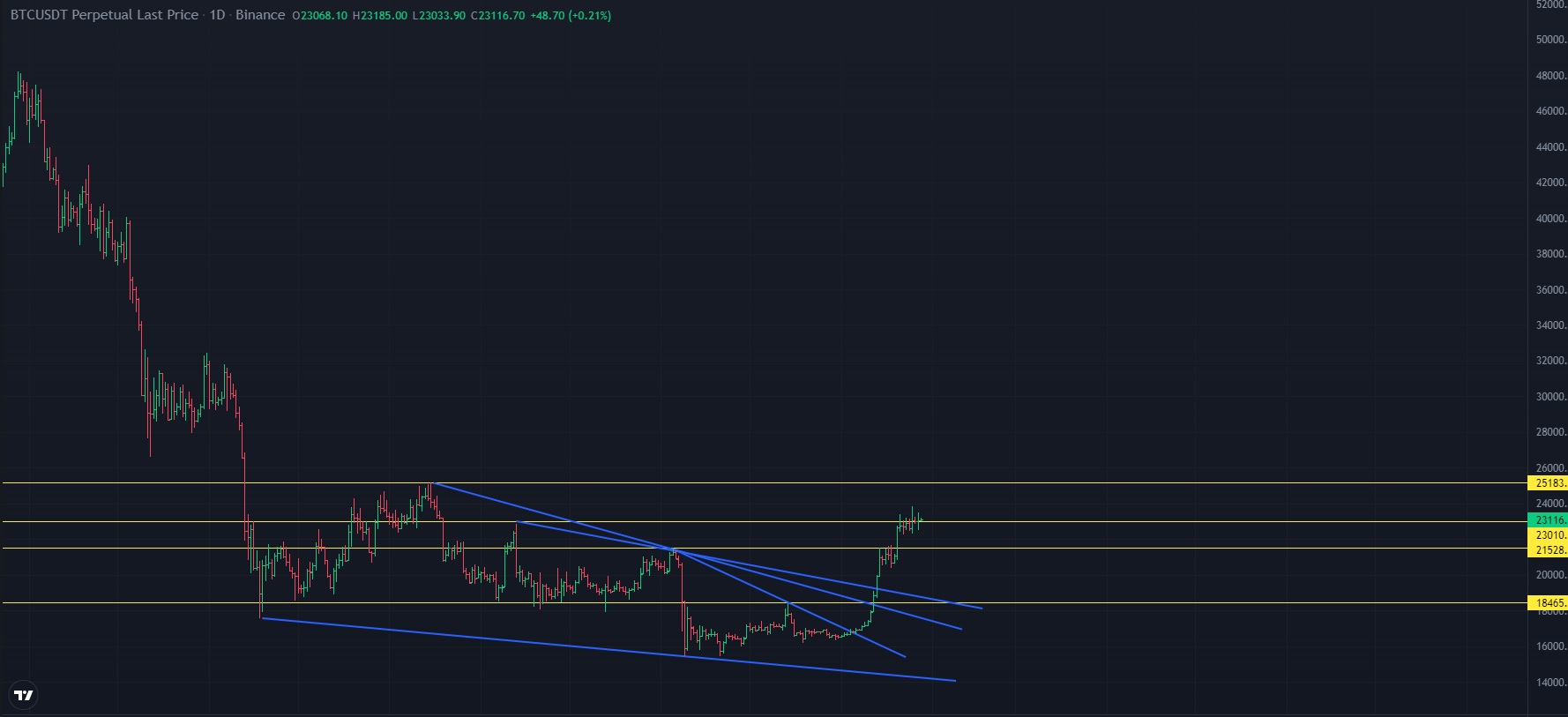
Bitcoin has crossed an important level of $22,800. The overcoming of this extremum in the medium term indicates the weakening of the seller’s forces after almost a two-year bear market.
For about a week, the first cryptocurrency has been moving in a narrow sideways trend of $23,500-22,500. The second wave of growth without a rollback, the price is holding at its local highs. There are no sales.
Five months ago, starting in June 2022, the price was in a large sideways accumulation of $18500-22500. Two recent waves of growth not only returned the price to this range, but broke through it impulsively and helped to gain a foothold higher. This is a very strong bullish signal.
There are no increasing actions of sellers, if you follow the analysis of volumes. The market is growing, but there are no volumes and the price is not restrained.
Btcusdt
On the liquidation chart, there is a noticeable decrease in sales during the growth of bitcoin in recent days, there are no peak liquidations, and this can be explained by the fact that the main crowd is now out of the market and does not understand, and enters longs in small amounts, which is noticeable in the chart below.
The appearance of the first peak liquidations will indicate that a crowd of bears is returning to the market.
The number of bank employees in the EU countries with an annual salary of more than €1 million in 2021 amounted to more than 1.9 thousand people.
This is a record figure for the entire time of data collection, since 2010When calculating, experts no longer take into account the UK, which left the European Union in 2020.
Before that, it was the constant leader of the rating: for example, in 2017, the number of bankers from this country with an earnings of €1 million was 3,567 people.