Double head and shoulders

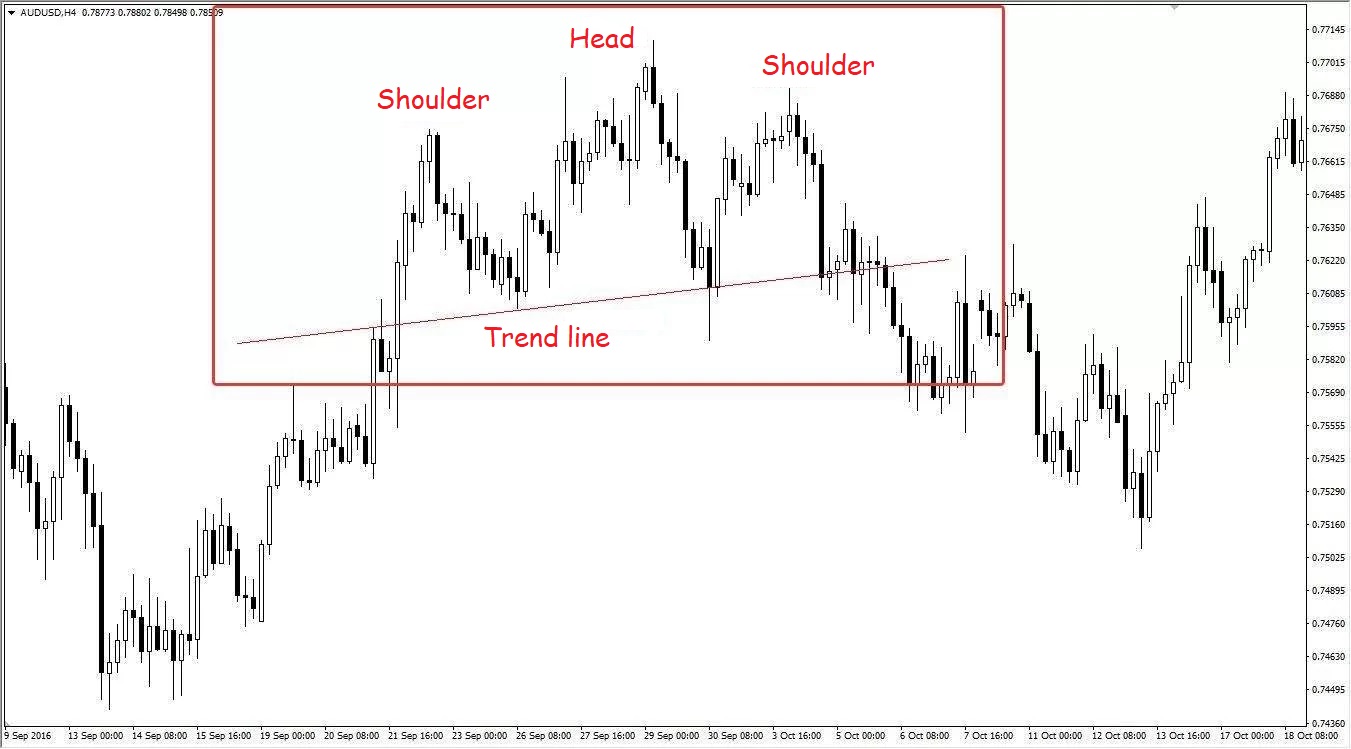
One of the reversal patterns on the chart is head and shoulders. This model has clear rules for construction and identification. However, there are some of its configurations that also indicate a trend reversal.


Reversal patterns of technical analysis

Before changing direction, the prevailing trend in the market will give a signal. This is what the founder of technical analysis, Charles Dow, said. Based on how the price behaves, we can draw a conclusion about what is happening with the balance of power in the market.

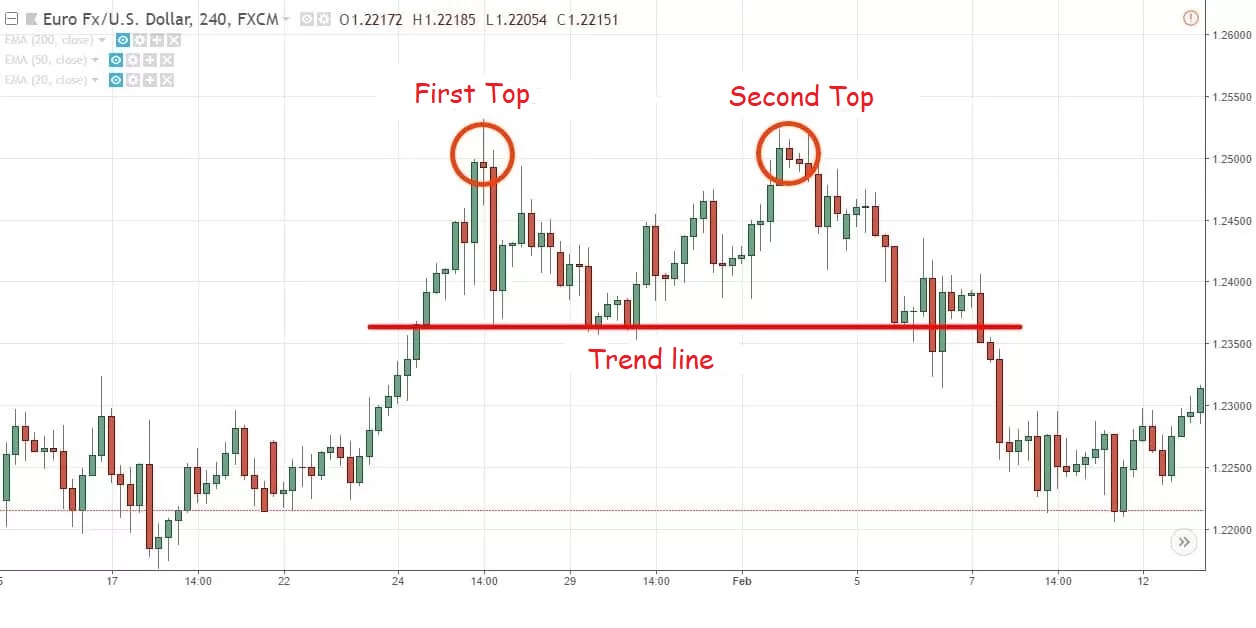
When a trend changes from upward to downward, one of three patterns can be seen on the chart: head and shoulders, double top and triple top. They are sometimes confused by calling double top and double head and shoulders.

Head and shoulders
Head and shoulders


double top
double top


triple top
triple top


To understand why a reversal occurs, you need to know what a head and shoulders pattern means. Price growth in an upward trend is due to the dominance of buyers. After the growth stage, some players take profits, provoking a downward correction. However, in an uptrend, each subsequent low and high are higher than the previous one.

The moment a head and shoulders, double top or triple top (a variation of the head and shoulders pattern) appears on the chart, it becomes clear that the price cannot overcome the previous high. This means that the strength of the bulls is weakening, and dominance is passing to sellers, foreshadowing a break in the trend.


How does the head and shoulders pattern work?

Regardless of whether a double head and shoulders, double or triple top pattern appears on the chart, these patterns trade approximately the same.

First, it is necessary to correctly define the model – it must be preceded by an upward trend. In a downward trend, these figures will be formed in a mirror image: triple and double bottoms, head and shoulders inverted (inverse) will be signals of a change from a downward trend to an upward one.

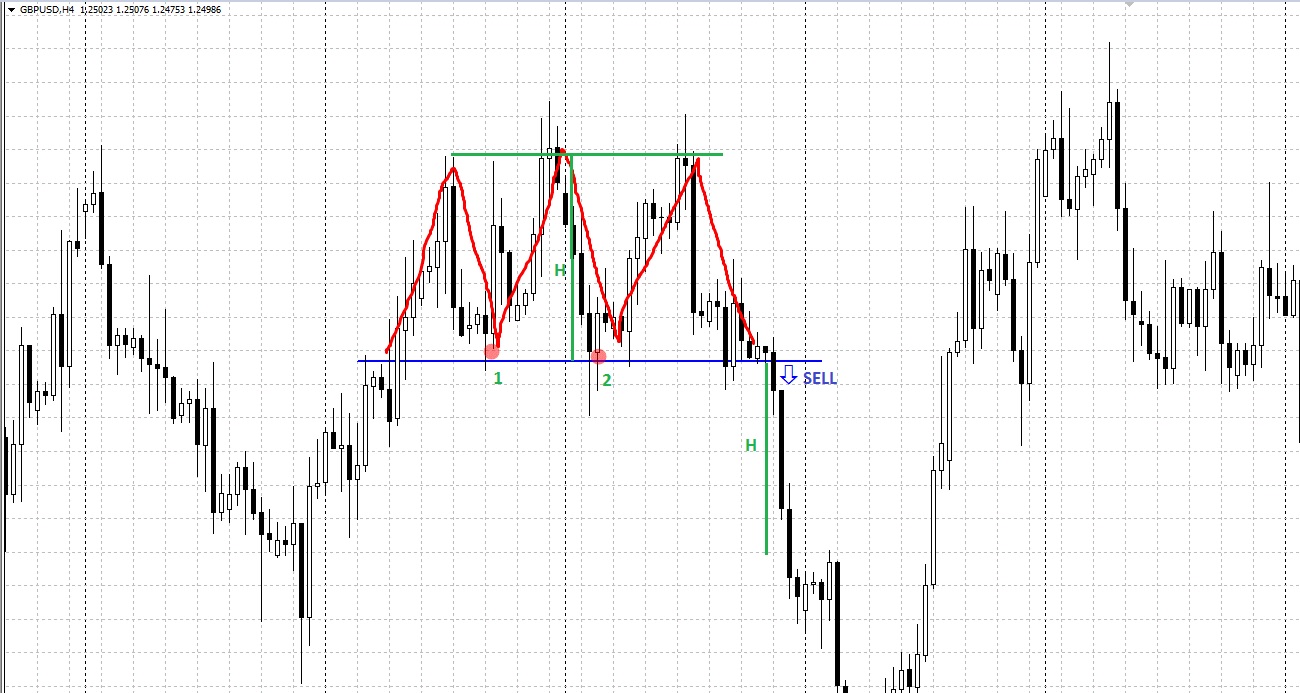
Secondly, using the lows of the figures formed at the top of the uptrend, it is necessary to draw a neckline. This is the border, upon the breakdown of which a bearish signal is formed.

A sell trade must be placed after the neck line is broken. Already on the next candle after the breakout, which has opened and is forming below the level, you can open a position.

To determine the target and take profit, it is necessary to measure the height of the figure’s head or the overall height of the pattern if we are talking about a double or triple top pattern. It must be moved down from the breakout line and a take profit should be set there.


Automatic trading on the stock exchange

Automated trading opens up opportunities to make money on the stock exchange, ahead of the human factor. In addition, now among large market participants more than 70% of all trading operations are carried out by robots. What automated Forex trading programs are available to private investors?


Features of automatic trading

Manual trading on the stock exchange or forex is available to all private investors. It will bring systematic profit if transactions are concluded not chaotically, but on the basis of one verified income strategy.

Some of these strategies, which do not involve the factor of human intuition when making decisions, can be automated by creating an algorithm that will independently analyze the market, read the trading signal, and open and close Forex trades.

A program for automatic trading on the stock exchange is called a robot or advisor. Their algorithms are built, as a rule, on the basis of mathematical indicators, technical analysis strategies, as well as candlestick patterns, which the program can easily read from the chart.

Robots constantly monitor the market to search for conditions specified in the robot’s algorithm. When these conditions are met, a trade is opened. You can also set parameters for stop loss and take profit, conditions for increasing the volume of positions, and criteria for risk management.
Where can I get a trading robot?

To earn money without manual trading, you need a program for automatic earnings on Forex – a robot or advisor. Where can I get it?

Automate your own strategy. If the trading system is simple and amenable to algorithmization, it can be turned into a robot. To do this, you need to either study programming in MQL yourself, or assign such a task to specialists. A program for automatic trading on Forex will be an excellent solution for those who have worked out the strategy well, are convinced of its profitability, and know how to set the parameters correctly. In addition, this will eliminate emotions and the influence of the human factor.
Download for free or buy a ready-made robot. In this case, scalpers or robots that trade on news are very good advisors. They allow you to overcome the limitation in the speed of placing orders. Multi-currency work, using several strategies to simultaneously analyze a number of currency pairs, would also be a good solution.

Automated trading: benefits and precautions?

Now anyone can trade Forex with the help of robots. But these ways of earning money, along with the benefits, also have pitfalls.

The automatic trading program saves time and removes the limitations of the human factor – the psychological component and limits in speed and reaction. Experienced traders who have automated their strategy continue to monitor its operation, tweak and improve the robot if necessary.

Beginners are often tempted to avoid the need for training and try to replace the ability to analyze the market with a robot. This often works against them, as advisors have their own pitfalls.

Often the algorithms of robots, especially high-yield ones, incorporate Martingale averaging methods or use order grids. This significantly increases the risks and, if the initial lot is set incorrectly or the deposit is small, it can lead to losses.

To prevent this from happening, it is important to understand the algorithm of the program that is used for automatic trading. Before you start working, you need to test the robot on a demo account or cent accounts to ensure profitability and understand the maximum drawdown size.

How to calculate profit factor

Profit factor is one of the most commonly used statistical indicators of the effectiveness of an exchange trading system. The higher the profit factor, the lower the actual risk that a trader faces when working with such a system.

The profit factor is calculated as the ratio of the amount of profit from all transactions to the amount of losses from all transactions. The optimal value is considered to be a value greater than 1.6.

For example, the system brought 6980 points of profit (the sum of all profitable trades) and 1898 points of losses (the sum of all unprofitable trades) during the month. What will be its profit factor?

Divide 6980 by 1898 and get a value of about 3.6. This means that the system is quite stable and can be profitable in the long term. But what’s even more important is that when trading using it, the trader has a small risk of loss. And as you know, for most traders, especially those trading with large capitals, reducing the risk of losses is an even higher priority goal than increasing profits.

Thus, measuring and analyzing the profit factor will allow you to understand how effective the trading system is and whether changes need to be made to reduce the risk that the trader bears when working on it.
Some experts advise not to take into account the most successful trade of the period, or even a number of such trades, when calculating the profit factor. The point here is to reduce the influence of happy accidents and present the profit factor in a more realistic form. In this case, the most unprofitable trade is always taken into account. This approach is practiced precisely because the very idea of analyzing the profit factor is already associated with the desire of an investor or trader to choose for himself options for trading systems with minimal risk.

In addition to the real profit factor (which is calculated based on already completed transactions), you can also calculate the predicted one, which depends on the ratio of the distance to the Stop Loss and Take Profit orders. For example, if the standard distance to TakeProfit, divided by the standard distance to StopLoss, is less than 2, then such a system is likely to be unprofitable in the long term, or extremely unprofitable.

Another important point is the period for which the analysis is carried out. However, it is not so much the period as the number of transactions that is important. Obviously, if there are only 2 transactions, and both are winning, then it will not be possible to calculate the profit factor at all. When there are 10, 20 or more transactions, it becomes possible to see the objective value of the profit factor and draw conclusions about the effectiveness of the system.

Hashrate

The concept of hashrate

All cryptocurrencies use the blockchain principle (a continuous chain of blocks – hence the name), according to which each subsequent block stores information about the previous one. It is this approach that provides networks with stability and security due to the impossibility of interference in the chain from the outside.

Each block is a piece of information packaged in a certain way, for example, about a transaction on the network. The most important part is the unique title. It strictly complies with the rules established on the network and allows you to uniquely identify a block, that is, enter information into the database and then, if necessary, retrieve it.

The header is generated by solving a complex cryptographic problem, during which a given amount of information is converted into a unique set of characters of a given length. This transformation is called hashing, and the resulting set of characters is called a hash. Each cryptocurrency network uses a specific hashing algorithm, which determines the rules for calculating the hash.

It also specifies the acceptable block header format. For example, for the Bitcoin network it might look like this:

0000000000000000002037646f063ea032548c4906a6a2b6e16d7ee90c8ba9bc

To find a header that matches the conditions specified on the network, you need to perform a certain (quite large) number of hashing operations. This is exactly what users’ equipment does when mining cryptocurrencies. The number of such operations per unit of time may vary. This is what is called speed, often hardware performance or hashrate.

Hashrate also has another meaning, which is used as a characteristic of the network as a whole. This indicator reflects the total number of hash calculations per second performed by all equipment included in the network.
How is hashrate measured?

So, hashrate is the number of hashing operations or hash calculations performed by equipment per unit of time. The reference unit of time is 1 second, that is, the hashrate is measured in hashes per second (h/s, H/s). Since the performance of modern equipment is high, and the blockchain networks of almost all cryptocurrencies include millions of pieces of equipment, they often operate in multiples of units:


Unit Console Number of zeros
kH/s Kilo 3 (thousand)
MH/s Mega 6 (million)
GH/s Giga 9 (billion)
TH/s Tera 12 (trillion)
PH/s Peta 15 (quadrillion)
EH/s Exa 18 (quintillion)
ZH/s Zeta 21 (sextillion)

That is, when they talk about kH/s, kilohashes per second (they practically don’t talk about them anymore, since equipment performance has left such numbers far behind), they mean that several thousand hash calculations are performed per second. 2 EH/s means two quintillion (2 followed by 18 zeros) hashes are calculated per second. For example, as of August 20, 2023, the current hashrate of the Bitcoin network was 473.4 EH/s. This figure clearly illustrates what kind of computing power is involved in the extraction of the first cryptocurrency.

Hashrate value for blockchain networks

Hashrate shows how many hashing operations the equipment (whether an individual miner or the network as a whole) performs per unit of time. It is logical to assume that the larger this value, the shorter the time it takes to calculate the correct header (finding a block) in the blockchain network.

From a miner’s point of view, an increase in hashrate is equivalent to an increase in profitability. Indeed, the more often the user’s equipment finds the correct (valid) block, the more often its owner receives a reward. On the Bitcoin network it is currently 6.25 coins per block. After the next halving (halving), which will occur approximately in April 2024, it will decrease to 3.125 coins.

Since the frequency of receiving rewards is directly related to hardware performance (hashrate), miners strive to increase it using various methods. Of course, you can buy tons of equipment and earn a decent income. However, there are several obstacles along this path:

Mining equipment is expensive, so increasing your own capacity is not so easy.
The networks have grown so large, and their hashrate is so high, that an individual user is unlikely to be able to assemble a mining rig with such productivity to obtain an acceptable (which is not calculated in years) probability of finding a block.
If each user increases the computing power of their equipment, the hashrate of the entire network will increase accordingly, which will practically not change the situation for an individual miner.
A good option is to increase performance without changing the network hashrate. This is exactly what miners do when they join together in pools. The total computing power of such a union allows valid blocks to be generated quite often. In this case, the reward is divided between the participants, bringing them income that they do not need to wait for years.

Hashrate and network complexity

Reducing the time it takes to mine a block and pay out rewards is not an absolute advantage from the network’s point of view. On the contrary, in the Bitcoin network, for example, the mining time for the next block is approximately the same – about 10 minutes. To implement such a limitation, some kind of counterbalance to the growth of hashrate is required. This counterbalance was the growing complexity of the network.

Network complexity is usually called the average number of hashing operations required to obtain the next valid block. If this indicator grows at the same rate as the hashrate, the speed of finding a block will remain unchanged. This principle is used in all cryptocurrency networks.

Difficulty adjustment is carried out by changing the type of valid block. In the Bitcoin network, the type of header for which is shown above, the difficulty is changed by adjusting the number of leading zeros in it.

On a note! The complexity of the network is determined not by hashrate measurements, but by the time spent generating a certain number of previous blocks. So, in the Bitcoin network this number is 2016. That is, recalculation is carried out every 2016 blocks, and the difficulty is set so that it takes about two weeks to find the next 2016.

Thus, for a miner, hashrate turns out to be the main indicator. Using it, he selects equipment that will bring (taking into account electricity costs and commissions) the desired profitability. At the same time, the performance of the equipment is its hashrate, and when choosing, its relationship with the overall hashrate of the network and its complexity is taken into account.


RU: Хешрейт

Понятие хешрейта

Все криптовалюты используют принцип блокчейн (непрерывной цепочки блоков — отсюда и название), согласно которому в каждом последующем блоке хранится информация о предыдущем. Именно такой подход обеспечивает сетям устойчивость и безопасность из-за невозможности вмешательства в цепочку извне.

Каждый блок представляет собой определенным образом упакованную порцию информации, например, о транзакции в сети. Важнейшей частью является уникальный заголовок. Он строго соответствует установленным в сети правилам и позволяет однозначно идентифицировать блок, то есть внести информацию в базу данных и затем при необходимости получить ее.

Заголовок формируется путем решения сложной криптографической задачи, в ходе которой заданный объем информации преобразуется в уникальный набор символов заданной длины. Такое преобразование называется хешированием, а полученный набор символов — хешем. В сети каждой из криптовалют используется определенный алгоритм хеширования, который и определяет правила вычисления хеша.

Задается в ней также и допустимый формат заголовка блока. Например, для сети биткойн он может иметь следующий вид:

0000000000000000002037646f063ea032548c4906a6a2b6e16d7ee90c8ba9bc

Чтобы найти заголовок, соответствующий заданным в сети условиям, нужно выполнить некоторое (достаточно большое) количество операций хеширования. Именно этим при майнинге криптовалют занимается оборудование пользователей. Количество таких операций в единицу времени может быть различным. Именно оно называется скоростью, чаще производительностью оборудования или хешрейтом.

Есть у хешрейта и другое значение, которое используется как характеристика сети в целом. Этот показатель отражает общее количество расчетов хешей в секунду, которое выполняет все включенное в сеть оборудование.

В чем измеряется хешрейт

Итак, хешрейт — это количество операций хеширования или расчета хешей, производимых оборудованием в единицу времени. За эталонную единицу времени принята 1 секунда, то есть измеряют хешрейт в хешах в секунду (h/s, H/s). Поскольку производительность современного оборудования высока, а блокчейн-сети практически всех криптовалют включают миллионы единиц оборудования, чаще оперируют кратными единицами:

Единица измерения Приставка Количество нулей
kH/s Кило 3 (тысяча)
MH/s Мега 6 (миллион)
GH/s Гига 9 (миллиард)
TH/s Тера 12 (триллион)
PH/s Пета 15 (квадриллион)
EH/s Экса 18 (квинтиллион)
ZH/s Зета 21 (секстиллион)

Те есть, когда говорят о kH/s, килохешах в секунду (сейчас уже практически не говорят, поскольку производительность оборудования оставила такие цифры далеко позади), имеют в виду, что производится несколько тысяч вычислений хешей в секунду. 2 EH/s означает, что в секунду вычисляется два квинтиллиона (2 с 18 нулями) хешей. Например, на 20 августа 2023 года текущий хешрейт сети биткойн составил 473,4 EH/s. Эта цифра хорошо иллюстрирует, какие вычислительные мощности задействованы в добыче первой криптовалюты.


Значение хешрейта для блокчейн-сетей

Хешрейт показывает, сколько операций хеширования выполняет оборудование (неважно, отдельного майнера или сети в целом) в единицу времени. Логично предполагать, что чем больше это значение, тем меньше время расчета правильного заголовка (нахождения блока) в блокчейн-сети.

С точки зрения майнера увеличение хешрейта равносильно повышению доходности. Действительно, чем чаще оборудование пользователя находит правильный (валидный) блок, тем чаще его владелец получает вознаграждение. В сети биткойн оно сейчас составляет 6,25 монет за блок. После следующего халвинга (снижения вдвое), который придется ориентировочно на апрель 2024 года оно уменьшится до 3,125 монет.

Поскольку частота получения вознаграждений напрямую связана с производительностью оборудования (хешрейтом), майнеры стремятся наращивать ее различными методами. Конечно, можно закупать тонны оборудования и получать приличный доход. Однако на этом пути есть несколько препятствий:

  1. Оборудование для майнинга дорого стоит, поэтому наращивать собственные мощности не так уж и просто.
  2. Сети настолько разрослись, а хешрейт их настолько высок, что отдельному пользователю вряд ли под силу собрать майнинговую ферму такой производительности, чтобы получить приемлемую (которая исчисляется не годами) вероятность нахождения блока.
  3. Если каждый пользователь нарастит вычислительную мощность своего оборудования, соответствующим образом вырастет и хешрейт всей сети, что практически не изменит ситуацию для отдельного майнера.
  4. Хороший вариант — увеличить производительность без изменения хешрейта сети. Именно так поступают майнеры, объединяющиеся в пулы. Общая вычислительная мощность такого объединения позволяет генерировать валидные блоки достаточно часто. При этом вознаграждение делится между участниками, принося им доход, который не нужно ожидать годами.


Хешрейт и сложность сети

Уменьшение времени, уходящего на добычу блока и выплату вознаграждения, с точки зрения сети не является безусловным плюсом. Наоборот, в сети биткойн, например, поддерживается примерно одинаковое время добычи очередного блока — порядка 10 минут. Чтобы реализовать такое ограничение, требуется некий противовес росту хешрейта. Таким противовесом стал рост сложности сети.

Сложностью сети принято называть среднее количество операций хеширования, необходимых для получения очередного валидного блока. Если этот показатель будет расти теми же темпами, что и хешрейт, скорость нахождения блока останется неизменной. Этот принцип используется в сетях всех криптовалют.

Регулирование сложности осуществляется путем изменения вида валидного блока. В сети биткойн, вид заголовка для которой приведен выше, сложность меняют корректировкой количества ведущих нулей в нем.

На заметку! Сложность сети определяют не по замерам хешрейта, а по времени, которое было затрачено на генерацию определенного количества предыдущих блоков. Так, в сети биткойн это количество составляет 2016. То есть пересчет ведется каждые 2016 блоков, а сложность устанавливается такой, чтобы на нахождение следующих 2016 потребовалось порядка двух недель.

Таким образом, для майнера хешрейт оказывается главным показателем. По нему он выбирает оборудование, которое принесет (с учетом затрат электроэнергии и комиссий) желаемую доходность. При этом производительность оборудования и есть его хешрейт, а при выборе учитывают его соотношение с общим хешрейтом сети и ее сложностью.

Futures. Definition and types of futures

Futures are one of the types of derivative financial instruments (derivatives), a futures contract that fixes the obligations of the parties to conclude a deal in the future on agreed terms. This definition may seem confusing to many retail investors and private traders. However, in fact there is nothing complicated here.

Let’s imagine a situation that a potential buyer would like to purchase a batch of 1000 units of goods. At the same time, he assumes that in six months, when he needs this product, its price will increase significantly. Therefore, he is interested in paying current prices. There is a seller on the market who is satisfied with the current price for this product. However, it still needs to be produced and a batch of the same 1000 units will be ready in just six months. These participants can enter into an agreement among themselves, under which the seller undertakes to supply and the buyer to pay for the goods, indicating in its terms:

  • completion date – in six months;
  • batch size – 1000 units;
  • calculation at the price fixed at the time of conclusion of the contract.

In fact, such an agreement is a futures contract.

Thus, it becomes possible to explain what futures are on the exchange in simple words. These are contracts (agreements) under which the buyer and seller obliged after a certain period of time (that’s why it is called urgent) to make a transaction on the terms specified at the time of conclusion of the contract.

All that remains to be clarified is the concept of a derivative instrument. Here, in principle, there is nothing complicated either. The contract is concluded regarding some asset, for example, wheat, precious metals, energy resources, shares, etc. This asset is called the underlying asset. Accordingly, a futures is a trading (exchange) instrument produced, or rather, derived, from the underlying asset.

In trading on world markets, contracts with future execution are widely practiced. Such agreements are concluded among themselves, for example, by producers and consumers of goods such as wheat and other agricultural products, oil, gas, metals (i.e., commodity market assets). Futures, in comparison, have 2 main differences:

Forwards are settled “here and now”, at the time of conclusion of the contract, and delivery is made within the agreed time frame. Futures are settled and delivered at the time of execution (expiration) of the contract.
Forward contracts are concluded outside of an exchange, can have any characteristics and, as a rule, are one-time or renewable. A futures contract is an agreement with standardized parameters, concluded on an exchange that guarantees the fulfillment of obligations by the parties, and is repeatable (multiple).

Futures characteristics and specification

Futures is a standardized futures contract for which the following characteristics are established:

Performance (expiration) period is the duration of the contract. In the practice of exchange trading, weekly, monthly, quarterly, semi-annual and annual futures are used. In addition, there are so-called One-day (or “perpetual”) futures, which are valid for one trading day and are automatically extended the next. Such contracts are traded mainly on centralized cryptocurrency exchanges. In 2022, on the Moscow Exchange (for the first time in the world on a traditional exchange platform), 3 such contracts were put into circulation at the US dollar-Russian ruble, euro-ruble and yuan-ruble rates.

These and other characteristics are specified in a document called a contract specification and fully describe the exchange instrument. The specification includes the characteristics already described, as well as:

Contract name and codes. For example, the “perpetual” futures for the dollar ruble on the Moscow Exchange is called “One-day futures contract with auto-extension for the US dollar – Russian ruble exchange rate” and has the code USDRUB.

  • Its type is delivery or settlement;
  • The units in which quotations are presented, for example, gold futures are quoted in US dollars per troy ounce;
  • Price step and its cost;
  • Guarantee provision (GS).

Collateral is one of the features of exchange futures, which is associated with the settlement procedure. It is said above that settlement of futures contracts is made at the time of execution (expiration). Thus, at the time of concluding the contract, it is not necessary for the buyer to have the entire amount in the account to pay for it. Similarly, it is not necessary for the seller to have the entire volume of the underlying asset at the time of selling the futures.

But to guarantee the fulfillment of obligations, certain amounts or volumes of assets are reserved in their accounts, which cannot be involved in other transactions. They are called guarantees. As a rule, the GO is from 10 to 20% of the value of the underlying asset at the time of purchase/sale of the futures.

As a result, for a trader, futures trading is analogous to unsecured margin transactions. This ensures high profitability of futures trading, but at the same time significantly increases its risks.

Types of futures

As stated, the specification of futures contracts indicates their type. There are two of them:

Deliverable futures. It assumes that at the time of expiration the underlying asset is delivered from the seller to the buyer. For example, when one futures contract for Gazprom shares is concluded on the MICEX, upon execution, the seller transfers 100 shares (1 lot) to the buyer, and the buyer pays for them at the price fixed at the time of purchase of the futures. By the way, all stock futures on the Moscow Exchange are deliverable.
Settlement. In this case, the underlying asset is not delivered, and the buyer and seller pay for it in money. Those. if a gas futures was purchased, and the gas price has risen, at expiration the seller pays the buyer the difference in prices at the time of execution and purchase of the contract. The seller suffers a loss, the buyer makes a profit. If the price of gas has decreased, the buyer will pay the seller the difference in prices and will be at a loss. The seller will receive a positive financial result.

How to trade futures

Futures trading is not much different from transactions with other exchange assets. The trading participant must have a brokerage account with access to the derivatives market. In Russia, contracts are traded on the Moscow Exchange derivatives market (FORTS). Not all brokers provide access to it for private clients; the possibility of trading needs to be checked. In addition, some brokers require a separate account or sub-account for trading in the derivatives market. In this case, they will have to be opened. If a broker, such as Finam, allows trading contracts directly from a brokerage account, no additional action is required from the investor. The latter option is much more convenient, since it allows you to use any liquid assets accounted for in a brokerage account as GO.

After all preparatory operations, the trading participant can place orders to buy and sell futures. The main requirement is that there must be enough funds in the account to reserve the guarantee collateral. More detailed instructions, as well as futures trading options, are provided here.

The guarantee of fulfillment of obligations under futures contracts is the exchange. In most cases, it acts not so much as an intermediary, but rather as a central counterparty for such transactions. This means that the exchange guarantees each trading participant the conclusion of a transaction, acting as a buyer for the seller of the contract and a seller for its buyer. This also allows you not to wait for the contract to expire, but to make a reverse transaction at any time.

However, in futures trading, the liquidity indicator is of great importance. To reduce risks, it is recommended to trade only highly liquid contracts. For example, the most liquid futures on the Moscow Exchange for different types of underlying assets:

  • for shares of Gazprom, Sberbank and VTB;
  • on the RTS, Moscow Exchange and S&P 500 indices;
  • for exchange rates – yuan-ruble and dollar-ruble;
  • for commodity assets – natural gas, gold and Brent oil.

In general, futures are highly profitable instruments, trading on which is available to all private investors without restrictions. Due to the high risk, non-qualifiers will have to undergo testing to conclude the first deal. The contract trading technology itself is practically no different from operations with assets on the spot market.

Leverage in trading

The concept of “leverage” is often encountered by novice traders who do not yet have their own impressive capital, but want to have the opportunity to trade in the markets. What is leverage? What opportunities does it provide? Is this tool always useful? What are the risks when using leverage? What mistakes should you avoid when using leverage?


Leverage – what is it in simple words

Leverage is a brokerage service that is a loan in the form of cash or securities provided to a trader to secure a transaction. The loan size can exceed the amount of the trader’s deposit by 10, 20, 100 or more times. By analogy with the law of physics, leverage works as a lever, allowing a trader to enter into transactions that he would not be able to do with his own funds alone. The maximum leverage on the exchange does not depend on the desire of the trader and the capabilities of the broker. It is calculated based on the risks established by the clearing center for each asset. For example, if for any stock the risk amount is determined to be 10%, a trader will be able to trade it with a leverage of 1 to 10. If the risk amount is 30%, then it is impossible to obtain a leverage of more than 1 to 3.

Carrying out transactions on the stock exchange using leverage is called margin trading. It represents the conclusion of purchase and sale transactions using borrowed funds issued against the security of a certain amount, which is called margin. In other words, in order to use the leverage service, you must have a minimum amount on deposit (set by the broker), which will be the collateral.

The amount of leverage in trading is the ratio of the trader’s own funds to the transaction amount (1:100, 1:1000). For example, if this ratio is 1:500, then the broker is providing a loan amount that is 499 times the investor’s deposit. In this case, the transaction uses one part of the investor’s funds and 499 borrowed funds.

The word “credit” scares many people away, but in fact there is nothing scary about this concept. Leverage can indeed be called a loan in the usual sense of the word, but the interest on the use of borrowed assets is significantly less than the usual banking ones. When transferring transaction positions to the next day, a commission is withdrawn from the account in the amount of the difference in discount rates on the loan and deposit – the so-called swap, which can be considered an analogue of the fee for using leverage.

The loss on the transaction is deducted from the trader’s own funds; if, as a result, their volume becomes less than the permissible minimum margin value, the broker will send an alert that the money is running out and the trader needs to either replenish the account or close the position. This alert is called Margin Call. If no action is taken, the transaction will be closed automatically (Stop out).


Leverage calculation example

The trader’s account has 100 US dollars, the loan amount is 1:100, the transaction amount is 10,000 dollars. In this case, the broker credits $9,900 so that the transaction amount is 10 thousand.=

If the transaction is unprofitable, then when the trader’s funds decrease to $20, it is forcibly closed. The transaction account remains at $9,920. The borrowed $9,900 goes back to the broker’s account, the trader’s loss is $80.

If the transaction took place and the profit was $1,000, then the account will have $11,000 after the transaction is closed. Of this, $9,900 will go to the broker’s account, and the trader will receive back his $100 and $1,000 in profit.


Leverage: Pros and Cons

For many traders who do not have their own capital, leverage is a financial opportunity because it can help you gain access to serious trades and make good money.

At first glance, this financial instrument has only one advantage:

  • allows you to conclude large transactions and make good profits;
  • provides beginners with the opportunity to quickly increase their own deposit several times;
  • allows you to place bets that exceed your financial capabilities.


But there are pitfalls when using borrowed funds. The main one is that leverage can increase the profitability of a transaction, but at the same time multiplies the risks. Therefore, the main task in margin trading is proper capital management. Let’s look at the advantages and disadvantages of leverage using a calculation example.

Let’s say a trader has $500 in his account and he decides to buy shares worth $100. Without using a loan, he will be able to purchase only 5 shares; he simply will not have enough money for more. But if he uses a broker’s loan of 1:100, he can afford to buy 100 times more shares, i.e. 500 shares.

If the deal goes in the desired direction, the value of the shares will increase. Let’s say it increased by $1 – then this will mean that when selling, the trader will receive an income of $1 from each share. It is easy to calculate that without the use of borrowed funds, the trader’s income would be only 5 dollars, and with them – 500 dollars. Not a bad result.

But the situation may be the opposite. If the transaction is unsuccessful and the price of the shares falls by $1, then without a loan the loss will be $5 – $1 for each share, and with the use of credit funds the loss will be equal to $500, i.e. the trader will lose his entire deposit.


Leverage for a trader and an investor: what is the difference

Trader and investor are different concepts. They trade the same markets, but use different strategies, which means they need different financial instruments. The leverage service will have features in both cases.

Put and call option

An option is one of the complex financial instruments, which is a contract that gives the trader the right to buy or sell a certain asset at a given price at a specified time. This investment instrument is used to hedge risks and make profit from speculative transactions. There are two types of option agreements: put and call.

What is a put option

A put option is a futures contract that gives its buyer the right to sell assets at a predetermined price at a predetermined time.

If an unfavorable situation arises (for example, a forecast of an upcoming reduction in price or price reduction), the trader has the right to sell the contract earlier than the agreed date. The decision to sell a financial instrument is made solely by its owner and may depend on current sentiment on the stock exchange. In this case, the buyer is obliged to purchase the asset, even if it is not profitable for him at the moment.

What is a call option

A call option is an agreement that operates inversely to a put option. It gives the buyer the right to purchase an asset at a pre-agreed price at a certain point in time, in the buyer’s interest for the asset to rise in price before the end of the contract period. If the situation develops unfavorably, the trader has the right to change his decision and refuse to purchase the underlying investment instrument. In this case, the seller has no right to choose. He is obliged to sell the asset at the first request of the buyer.

The compensation to the seller upon completion of the transaction is offset by an irrevocable premium. A certain amount is paid to the owner of the securities during the process of concluding the agreement and is not refundable, regardless of whether the agreement is fulfilled within the agreed period or the other party to the transaction changes his mind about buying the asset.

Difference between put and call options

The main differences between put and call contracts are:

Under the terms of a call agreement, the trader is given the right (but not the obligation) to purchase an asset on a certain date at an agreed upon price. A put gives the trader the right (without obligation) to sell an asset at a predetermined price at a specific time.

A call option makes a profit if the price of the underlying asset rises. The difference between a put option and the previous one is that it provides benefit when the value of an asset falls.

The buyer’s potential profit from transactions with call agreements is unlimited. In the case of put contracts, there is already a return limit on the holder’s income.

Despite the many significant differences between these investment instruments, the maximum loss from transactions with both types of contracts is not limited for the seller, and for the buyer is determined by the size of the premium.

Where are these options used?

Options are often used in speculative trading strategies. But due to the fact that this instrument is highly complex and involves an uneven distribution of risks between the seller and the buyer, many traders prefer futures.

The second important application of put and call contracts is hedging. This is the protection of investments from the risk of adverse changes in the value of assets using derivative financial instruments. Options contracts are ideal for this purpose.

If an investor wants to insure his investments against rising prices for underlying assets, he takes a long position (concludes a call option agreement). A put option works in a similar way to hedge the risk of a decline in the value of financial instruments.

Real stock options have nothing to do with so-called binary options

. The latter are mainly used by fraudulent companies that do not provide traders with the opportunity to earn money, but are focused only on taking money from them.

Options are used for hedging due to the use of an unsecured margin trading mechanism (leverage). As a result, options trading involves high risk.

Options are more often used by large investors, such as hedge funds. Private investors use them to make speculative profits. At the same time, there are many options trading strategies that actually break even. However, in order to succeed, you need to strictly follow their rules.

(RU) Фьючерс. Определение и виды фьючерсов

Фьючерс – один из видов производных финансовых инструментов (деривативов), срочный контракт, фиксирующий обязательства сторон заключить в будущем сделку на оговоренных условиях. Многим розничным инвесторам и частным трейдерам такое определение может показаться малопонятным. Однако фактически здесь нет ничего сложного.

Read More

(RU) Кредитное плечо в трейдинге

С понятием “кредитное плечо” часто сталкиваются начинающие трейдеры, которые еще не имеют собственного внушительного капитала, но хотят получить возможность торговать на рынках. Что такое кредитное плечо? Какие возможности оно дает? Всегда ли данный инструмент приносит пользу? Каковы риски при использовании кредитного плеча? Каких ошибок следует избегать при использовании кредитного плеча?


Кредитное плечо – что это простыми словами

Кредитное плечо – это брокерская услуга, которая представляет собой заем в виде денежных средств или ценных бумаг, предоставляемых трейдеру для обеспечения сделки. Размер займа может превышать сумму трейдерского депозита в 10, 20, 100 и более раз. По аналогии с законом физики кредитное плечо работает как рычаг, дает возможность трейдеру заключать сделки, которые были бы ему не под силу с одними только собственными средствами. Максимальное кредитное плечо на бирже не зависит от желания трейдера и возможностей брокера. Оно рассчитывается на основании установленных клиринговым центром рисков по каждому активу. Например, если по какой либо акции размер риска определен в 10%, торговать ей трейдер сможет с плечом 1 к 10. Если же величина риска составляет 30%, то кредитное плечо больше 1 к 3 получить невозможно.

Совершение операций на бирже с использованием кредитного плеча называется маржинальной торговлей. Она представляет собой заключение сделок купли-продажи с использованием заемных средств, выдаваемых под залог определенной суммы, которая называется маржой. Другими словами, чтобы воспользоваться услугой кредитного плеча, на депозите обязательно нужно иметь минимальную сумму (устанавливается брокером), которая и будет залогом.

Размер кредитного плеча в трейдинге – это отношение величины собственных средств трейдера к сумме сделки (1:100, 1:1000). Например, если этот показатель равен 1:500, значит, брокер предоставляет сумму займа, в 499 раз превышающую депозит инвестора. При этом в сделке используется одна часть средств инвестора и 499 заемных.

Слово “кредитное” многих отпугивает, но на самом деле ничего страшного в этом понятии нет. Кредитное плечо действительно можно назвать кредитом в привычном понимании этого слова, но проценты за пользование заемных активов значительно меньше, чем привычные банковские. При переносе позиций сделки на следующие сутки со счета снимается комиссия в размере разницы учетных ставок по кредиту и депозиту – так называемый своп, который можно считать аналогом платы за использование кредитного плеча.

Убыток по сделке вычитается из собственных средств трейдера, если в результате их объем станет меньше допустимого минимального значения маржи, брокер отправит оповещение о том, что деньги заканчиваются и участнику торгов нужно либо пополнить счет, либо закрыть позицию. Такое оповещение называется Margin Call. Если никаких действий предпринято не будет, сделка будет закрыта автоматически (Stop out).


Пример расчета кредитного плеча

На счете трейдера есть 100 долларов США, величина займа 1:100, сумма сделки составляет 10 000 долларов. При этом брокер кредитует  9 900 долларов, чтобы сумма сделки составила 10 тысяч.=

Если сделка убыточная, то при уменьшении средств трейдера до 20 долларов она принудительно закрывается. На счете сделки остается 9 920 долларов. Заемные 9900 долларов уходят обратно на счет брокера, убыток трейдера составляет 80 долларов.

Если сделка состоялась и прибыль составила 1000 долларов, то на счете по после закрытия сделки будет 11 000 долларов. Из них 9 900 долларов уйдут на счет брокера, а трейдер получит обратно свои 100 долларов и 1000 долларов прибыли.


Кредитное плечо: плюсы и минусы

Для многих трейдеров, которые не имеют собственного капитала, кредитное плечо является финансовой возможностью, потому как с его помощью можно получить доступ к серьезным сделкам и заработать хорошие деньги.

На первый взгляд, данный финансовый инструмент имеет одни только преимущества:

  • позволяет заключать крупные сделки и получать хорошую прибыль;
  • предоставляет новичкам возможность в короткие сроки увеличить собственный депозит в несколько раз;
  • позволяет делать ставки, которые превышают финансовые возможности.

Но есть при использовании заемных средств и подводные камни. Главный из них – кредитное плечо может повышать доходность сделки, но при этом кратно увеличивает риски. Поэтому основная задача при маржинальной торговле – это правильное управление капиталом.Рассмотрим преимущества и недостатки кредитного плеча на примере расчета.

Допустим, на счете трейдера лежит 500 долларов США, и он решил купить акции стоимостью по 100 долларов. Без использования займа он сможет приобрести только 5 акций, на большее количество ему просто не хватит денег. Но если он воспользуется кредитом брокера в размере 1:100, то сможет позволить себе приобрести в 100 раз больше акций, т. е. 500 штук.

Если сделка пойдет в желаемом направлении, то стоимость акций увеличится. Предположим, она выросла на 1 доллар – тогда это будет означать, что при продаже трейдер получит доход в 1 доллар с каждой акции. Несложно посчитать, что без использования заемных средств доход трейдера составил бы всего 5 долларов, а вместе с ними – 500 долларов. Неплохой результат.

Но ситуация может быть и обратной. Если сделка окажется неудачной и стоимость акций упадет на 1 доллар, то без кредита убыток составит 5 долларов – по 1 доллару с каждой акции, а с использованием кредитных средств убыток будет равен 500 долларам, т. е. трейдер потеряет весь свой депозит.


Кредитное плечо для трейдера и инвестора: в чем разница

Трейдер и инвестор – разные понятия. Они торгуют на одних и тех же рынках, но используют разные стратегии, а значит, нуждаются в различных финансовых инструментах. Услуга предоставления кредитного плеча будет иметь особенности в обоих случаях.