The policy of SEC Chairman Gary Gensler could lead to Joe Biden’s defeat in the upcoming U.S. presidential election in November. This was stated by Ripple CEO Brad Garlinghouse.
And this slander about “all crypto execs going to jail” from the man who completely missed FTX (and actually cozied up to SBF), and wasn’t even invited to the DOJ announcement about Binance.
The top manager was outraged by the official’s statements at the Bloomberg Invest summit in New York, where he said that key industry players “are either in prison, or going to jail, or awaiting extradition.”
Garlinghouse called these words “nonsense.”
“And this slander […] from a man who completely skipped FTX (and actually got closer to SBF) and wasn’t even invited to the announcement [by agreement] The Ministry of Justice about Binance. If Gensler had really “worked for the American people,” as he says, he would have been fired long ago. The head of the SEC will lead to Biden losing the election,” the CEO of Ripple added.
Ripple and the SEC have been in litigation since 2020, when the Commission accused Ripple of raising $1.3 billion by selling XP in the form of unregistered securities.
In July 2023, Judge Antonio Torres ruled in favor of the company. The case regarding the institutional sales of XRP by the company continues.
Recall that in May 2024, billionaire investor Mark Cuban said that Gensler’s position on cryptocurrencies could prevent Biden from being re-elected president.
A month later, he repeated his position.
Back in 2023, during a debate with ex-SEC lawyer John Reed Stark, the billionaire said that the regulator was “throwing cryptocurrency under the bus.”
Whenthestockmarketbubbleburstsandrecession sets in —WallStreetveteran
Paul Dietrich pointed to a highly overvalued market and cracks in the economy
The S&P 500 could be cut in half when the stock bubble bursts and the U.S. economy plunges into recession, Paul Dietrich believes.
“I believe that the upcoming recession will lead to a deeper decline in the stock market than in 2000 and 2008,” said chief investment strategist B. Riley Wealth Management in his latest monthly commentary.
A graph of the stock market decline and recession. Stocks could collapse by almost 50%, and a recession could come as early as this year, says Paul Dietrich of B. Riley. Yuichiro Chino/Getty Images
Dietrich described in detail the warning signs indicating that stocks are highly overvalued and close to correction. For example, he pointed to the price-earnings ratio in the S&P 500 and the inflation-adjusted Shiller PE ratio, which, excluding past recessions, are at multi-decade highs, as well as the index’s historically low dividend yield of 1.35%.
He also noted that the recent market growth was driven by investor enthusiasm for several stocks, such as Microsoft and Nvidia, and their hopes that the Federal Reserve would lower interest rates later this year, rather than fundamental factors such as rising corporate earnings.
Indeed, Dietrich compared the huge hype around AI to the Internet mania during the dotcom bubble. He also drew attention to the Buffett indicator, which rose to 188% this year – close to the 200% mark, when buying shares, according to Warren Buffett, would mean “playing with fire.”
In addition, the strategist noted that over the past year, the price of gold has jumped by about 20% to record highs. He explained this by saying that institutional investors are buying this safe haven asset because they expect “a serious correction or collapse of the stock market due to wildly inflated stock prices and a slowdown in economic growth.”
As for the economy, Dietrich argues that decades of excessive budget spending and artificially low interest rates have pushed back the recession.
He predicted that rates would remain raised for many years to combat persistently inflated inflation, and the government would be forced to raise taxes to solve the problem of bloated budget deficits, which would lower prices for assets such as stocks and houses and cause an economic downturn.
“No one seems to notice that the economy is cooling, and there are risks to it everywhere,” he said. “I still think there is a high probability that the economy will go into a mild recession this year.”
Dietrich noted that the S&P 500 typically falls by about 36% during a recession, and the index will have to drop 12% from its current level of about 5,450 points to return to the 200-day moving average. Thus, he warned that the index could fall by 48% to 2,800 points – the lowest level since the collapse of Covid in the spring of 2020.
The Wall Street veteran is one of several leading forecasters predicting a worsening stock market and an impending recession. But it is worth noting that Dietrich has been sounding the alarm for several months, but neither the market nor the economy have faced serious problems.
Foreign investors from unfriendly countries have their assets blocked on the Moscow Exchange.
Jim Rogers is no exception. In an interview with RBC Investments, he said that he believes in these investments and will continue to hold the papers
American investor Jim Rogers will not participate in the procedure for exchanging frozen assets, when foreigners buy frozen securities from Russians using funds from type C accounts. The billionaire expects that after the end of hostilities in Ukraine he will again be able to manage his investments. Rogers himself spoke about this in an interview with RBC Investments.
“I know that people talk about such things (exchange of blocked assets. – RBC Investments)
I don’t know the details because I doubt I’ll be a part of it,” he said.
Jim Rogers is known for co-founding the Quantum Fund with George Soros in the 1970s, which brought investors 4,200% return in ten years. Rogers has also invested in Russian assets; his portfolio includes shares of AFK Sistema, PhosAgro, Aeroflot, Moscow Exchange, as well as ruble government bonds.
According to Jim Rogers, hostilities always end, after which everything returns to normal. For this reason, the investor is also not interested in selling Russian shares from his portfolio.
“I’m still an optimist. I think that Russia has a good future in many areas. And I want to own Russian shares.
I don’t want to sell my Russian shares,” Rogers explained his position.
Since February 2022, residents of unfriendly countries cannot sell Russian assets through Russian brokers. Subsequently, special type C accounts were opened for such investors, into which only rubles are credited. In type C accounts, for example, foreigners receive coupons on bonds and dividends on stocks. The functionality of such accounts is limited – withdrawal of funds is possible only in a small number of cases. As of November 2022, the total volume of funds in type C accounts with the Central Bank was estimated at more than ₽280 billion. In April 2023, Deputy Minister of Finance Alexey Moiseev reported that the total volume of assets in type C accounts is comparable to the volume of frozen Russian assets abroad.
Jim Rogers is ready to put up with the fact that his Russian assets are effectively blocked. “I won’t say everything is fine.But I don’t mind, because I won’t sell my Russian shares under any circumstances,” he said. At the same time, the billionaire noted: buying shares of companies that suffered greatly during difficult times usually provides good opportunities in the future. Rogers said that companies such as Aeroflot or Moscow Exchange will not disappear anywhere; someday they will do very well again.
In November 2023, Russian President Vladimir Putin signed a decree that allows foreign investors, using funds in their type C accounts, to buy back from Russian investors their securities blocked in European depositories due to sanctions against NSD. Participation in the transaction is voluntary on both sides, and it is assumed that non-residents must themselves obtain the appropriate permissions from their regulators, since the papers they will receive from the Russians have yet to be unfrozen. Russian financial authorities have repeatedly said that they do not directly negotiate asset swaps with foreign investors and regulators.
In 2023, the ruble began to weaken; by October, the dollar rose by almost 50%.But in the last months of the year, the ruble was able to win back some of its losses.RBC Investments remembered what happened on the foreign exchange market in 2023
On the last working day of 2023, dollar trading on the Moscow Exchange closed at ₽90.36, the final euro exchange rate was ₽99.62, and the yuan exchange rate was ₽12.61. This is evidenced by the site data at 19:00 Moscow time on December 29. A year earlier, on December 30, 2022, dollar trading closed at ₽69.9, euro — ₽74.3, yuan — ₽9.912. Thus, over the year, the dollar exchange rate increased by 29.27%, the euro and yuan exchange rates by 34.08% and 27.23%, respectively.
Throughout most of 2023, the ruble has been steadily weakening due to the expanding share of its use in export payments and the rapid growth in demand for foreign currency from importers, PSB noted. In July, the Central Bank named the main reason for the fall of the ruble as a change in the trade balance due to a decrease in export revenues.
The Moscow Exchange already has futures for the S&P 500 and NASDAQ 100 indices.
The platform will expand this line with contracts for the Dow Jones and Russell, which will also be settlement. The exchange is also eyeing futures on the Chinese market.
In January 2024, the Moscow Exchange will launch two new futures on ETFs, which repeat the dynamics of US stock indices, Maria Patrikeeva, managing director for the derivatives market of the trading platform, told RBC Investments. Currently, futures for ETF units are already traded on the Moscow Exchange, the benchmark of which is the S&P 500, NASDAQ 100, Hang Seng, Euro Stoxx 50, Nikkei 225 and DAX indices.
“In January 2024, ETF futures will be launched that replicate the Dow Jones and Russell indices,” she said, emphasizing that these will be settled contracts that do not involve delivery of the underlying asset. “Investors can make money on price movements in a foreign market without the risk of owning the underlying asset,” Patrikeeva explained.
Previously, she said that the site would launch futures for the indices of Brazil, India and Turkey within six months. Now she added that the range of contracts for foreign indices could be expanded by other countries, in particular China.
“We have worked on this topic quite well and now we understand that there will be coverage of more than the three countries that we announced earlier. Also on top of this list we are thinking about China. We see a truly growing demand from participants for foreign assets,” Patrikeeva noted.
The Moscow Exchange also plans to begin trading in new perpetual contracts. “Next year we plan to launch new perpetual futures on foreign assets. We are currently doing a lot of analytical work. These will be very interesting instruments. We plan to start launching them in the first quarter of 2024,” said a representative of the exchange.
A perpetual futures contract differs from a traditional delivery contract in that it does not have an expiration (settlement) date. Expiration, that is, the date when the instrument expires, occurs every quarter – on this day the futures position must be closed. Otherwise, delivery of the underlying asset will take place. Perpetual futures do not have this feature – it is a one-day contract, every day it is automatically extended by one day. In fact, a perpetual futures is a convenient analogy for a spot instrument.
The first perpetual futures appeared on the Moscow Exchange in April 2022. Currently, the Moscow Exchange trades three perpetual futures for currency pairs (dollar, euro, yuan), a one-day contract for gold and the Moscow Exchange index.
Shares of South Korean enterprises specializing in the production of electronics components are rising amid US sanctions against Chinese companies
Shares of the South Korean cathode manufacturer Ecopro Co have outperformed the shares of all other companies from the Bloomberg world index (2,647 participants), providing a return of 571% since the beginning of 2023, the publication writes.
The yield of these securities is 200% higher than Kum Yang Co, which took second place in the rating.The South Korean company also produces components for electric vehicle batteries.Bloomberg associates investor interest in Korean battery manufacturers and their suppliers with the fact that a number of their Chinese competitors have fallen under US sanctions.In early October, the United States imposed sanctions against 42 Chinese firms.
The list included mainly companies working with electronics and technology.At the end of the same month, three more Chinese companies fell under sanctions; the United States accused them of transferring technology to Pakistan for the production of ballistic missiles.The stock’s gains were driven in part by expectations of increased orders for electric vehicle batteries earlier this year.The rise continued even as some analysts cut their demand forecasts.
As Bloomberg notes, before the government’s recent ban on short selling, Ecopro shares were one of the most popular among short sellers in South Korea.Let us remind you that the country introduced a ban on short selling of shares from November 6, 2023 until June 2024.
Regulators said the move was necessary to stop illegal trading tactics routinely used by hedge funds and other investors around the world.Following this decision, the South Korean stock market rose sharply.
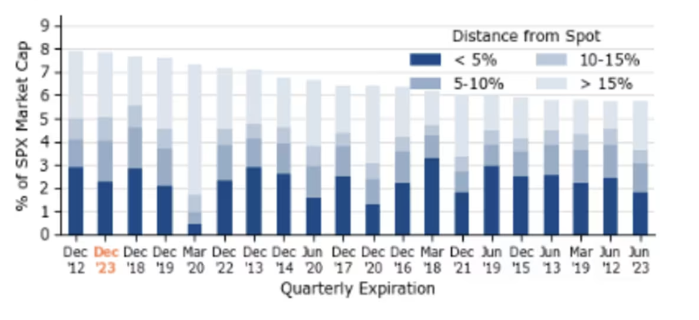
More than $5 trillion worth of stock options, index options and stock index futures expire today. In addition, the S&P 500 and Nasdaq-100 will be rebalanced on the same day
More than $5 trillion worth of stock options, index options and stock index futures expire today. In addition, the S&P 500 and Nasdaq-100 will be rebalanced on the same day
The redemption volume reaches 8% of the SPX market capitalization. This is the maximum since 2012. Source: Google
Analysts warn that events could move quickly and volatility could be off the charts as billions of dollars worth of contracts and securities change hands on this day. The face value of options expiring today is $5.3 trillion, with the largest redemptions taking place before the start of the American session.
On the one hand, many traders will take profits on bullish positions, but some will choose to roll them over to the next period to maintain risk hedging. Index fund managers will have to complete adjustments to their holdings before the announced index changes take effect.
Trading volumes have been growing since the beginning of the week. On the American stock market, stock trading volume reached $17 billion, Steve Sosnick, chief market strategist at Interactive Brokers, said this during a telephone interview with News. For comparison: on Tuesday, trading volume did not exceed $10.6 billion.
“Tomorrow the volume of trade in popular categories will be huge,” Sosnik added. “This is the largest option expiration of the year, which is understandable, December is always like this. But that is not all. Today’s event will likely be the largest redemption of SPX options in the last ten years,” Fishman said in comments to MarketWatch.
Brent Kochuba, founder of options market analytics platform Spotgamma, went even further, saying “this is the largest options redemption ever.”
There is a distortion in the market
Traders were buying bull options at a record pace amid surging markets, according to data from Cboe Global Markets, the largest operator of options exchanges in the United States. Trading volume in S&P500-related options reached 4.8 million contracts on Thursday, surpassing the previous all-time high reached on November 14, according to Cboe. Additionally, total trading volume in call options on all U.S. stocks topped 30 million contracts on Wednesday, marking the strongest bullish contract activity this year, according to Goldman Sachs Group.
Aggressive stock buying over the past month has helped push the S&P 500 close to an all-time high (based on closing prices), options market experts say. The S&P 500 SPX rose 8.9% in November, which was the best month of 2023 of the year and the eighteenth-best month in the last 73 years. It continued to rise in December, according to FactSet data. Since the beginning of the month, the index has risen by 3.3%.
Earlier this week, analysts warned that markets could face trouble as the S&P 500 approaches the 4,600 level. They explained that a “wall” of open interest in call options near that level could force market makers to put the brakes on the rally. However, traders knocked down that wall and pushed the index to 4700. The S&P 500 closed at 4719.55 on Thursday, its highest close since Jan. 12, 2022, according to FactSet data. The index is currently within 1.75% of its record close set on January 3, 2022 at 4796.56.
Traders’ bullish sentiment recently helped push the Cboe VIX volatility index, also known as Wall Street’s “fear gauge,” to multi-year lows.
It’s not just options and S&P 500 contracts tied to popular stocks like Tesla Inc. that generate volume. Call options trading volume tied to the iShares Russell 2000 ETF IWM (which tracks small-cap companies in the Russell 2000 Index) reached 1.35 million contracts, the third-highest ever, according to Goldman. Activity in options contracts related to small-cap stock indexes has been increasing since late October.
Heavy call option buying has driven the S&P 500 put-call ratio to its lowest level in a year, according to Goldman Sachs Group. This suggests that investors were buying up bullish contracts but avoiding bearish ones due to the sustained rise in the stock market. Goldman analysts are calling Friday “the last big event of the year.”
A unique coincidence of circumstances
“Triple Witching Friday” or “Witch Friday” happens once a quarter. On this day, futures on stock indexes, as well as options linked to individual stocks, ETFs and indices, expire. Experts note that they are usually characterized by more intraday fluctuations and higher trading volume.
This time the S&P 500 and Nasdaq-100 will be rebalanced after the markets close on Friday. This is typically a routine event, but it came into the spotlight this quarter because funds were forced to rebalance over the summer to limit exposure to large-cap Nasdaq-100 stocks.
Earlier this month, Standard & Poor’s announced its rebalancing plans, which included reducing the weighting of shares of Apple Inc and Alphabet Inc. GOOG, -0.57% GOOGL, -0.48%. At the same time, Amazon’s share. com will be increased. Three companies, including Uber Inc, will also join the index, while three others will leave it.
Kochuba believes this Friday’s expiration could remove the final barrier holding stocks back to record highs for the rest of the year.
“After OpEx, markets will no longer be held back,” he noted. OptionMetrics’ Garrett DeSimone cautioned that investors shouldn’t put too much weight on options market activity and other technical factors.
“At the end of the day, it’s all about macroeconomics,” he told News.
Moderna’s CEO said the company’s experimental melanoma vaccine could be available by 2025.The company’s shares reacted with rapid growth
Shares of biotech company Moderna rose 20.78% to $94.93 on the NASDAQ stock exchange as of 5:43 p.m. Moscow time.Demand for the stock surged amid Moderna CEO Stephane Bancel’s announcement that the company’s experimental melanoma vaccine could become available in just two years.According to the CEO, Moderna expects the product could be launched on an accelerated basis in some countries by 2025, Barron’s writes.According to the publication, in 2020, 325 thousand new cases of melanoma and 57 thousand deaths from this disease were registered worldwide.Unlike conventional vaccines, so-called therapeutic vaccines treat rather than prevent disease.
Clinical trial results showed improved chances of survival over time with the vaccine, which uses the same messenger RNA technology that has been shown to be highly effective against severe forms of COVID-19.Creating a cancer vaccine involves analyzing the genetic sequence of each patient’s tumor to create personalized therapy after surgery.The study involved 157 people diagnosed with stage III–IV melanoma.Moderna’s experimental vaccine combined with Merck’s immunotherapy drug Keytruda reduced the risk of relapse or death by 49% over three years compared with Keytruda alone.
Last year, Moderna announced the results of two years of monitoring, which showed a 44% reduction in risk.Thus, existing clinical data could form the basis for conditional approval of the vaccine, Bancel said.Modern’s shares have fallen by about 48% since the beginning of the year.At the end of the third quarter of 2023, the biotechnology company reported a net loss of $3.6 billion. The company attributed the loss mainly to one-time write-offs associated with reduced capacity to produce COVID-19 vaccines.The company’s revenue decreased by 1.8 times – to $1.831 billion. The company announced that it plans to reach breakeven in 2026.
Brad Garlinghouse said the US, following the example of the UK and some other countries, should simultaneously encourage innovation and protect consumers
Ripple CEO Brad Garlinghouse called the United States one of the “worst places” to launch cryptocurrency projects. He announced this at the Token 2049 conference in Singapore, writes Cointelegraph.
“The only country in which I would not recommend opening a company at this time is the United States,”Garlinghouse said.
At the same time, Singapore, Great Britain, the UAE and Switzerland are countries where “smart” policies are being implemented to regulate the crypto market, says the head of Ripple. He said the United States should follow the example of these countries by simultaneously encouraging innovation and protecting consumers.
rbc.group
Gaprlinghaus believes that this situation was led to by the actions of the US Securities and Exchange Commission (SEC), which through numerous lawsuits is waging a “political war” with the industry.
In September, the US Congress introduced an updated bill against the digital dollar. The document prohibits the Fed from issuing retail digital currencies, and also supports US values of protecting privacy, individual sovereignty and competitiveness in the free market.
The global nuclear power industry will increase its capacity by three-quarters in the coming decades, according to an industry report prepared by the Nuclear Association. If you don’t quickly start developing new mines, there will be a shortage on the market very quickly.
On Thursday, the World Nuclear Association, in its first market report since 2021, said there were 391 gigawatts of nuclear power plants worldwide, meeting a tenth of global electricity demand. According to the forecast, by 2040 this figure will increase to 686, and possibly to 931 gigawatts.
At an event in London, industry executives said the accompanying rise in fuel demand would lead to a reduction in uranium supplies. After the disaster at the Fukushima nuclear power plant in Japan in 2011, which led to the closure of dozens of reactors, the uranium market was dormant for ten years. Mining companies have cut production due to low prices.
However, Japan has recently restarted reactors, and new reactors have come online in the US, Europe and Asia. The Inflation Reduction Act has prompted US utilities to extend the life of existing reactors.
Miners and other companies in the complex nuclear fuel supply chain are scrambling to ramp up production to meet increased demand, traders said. As a result, uranium prices in recent days have reached near their highest levels in a decade.
Shares of uranium miners, including New York-listed Uranium Energy and Toronto-listed Denison Mines, are rising strongly. So are shares of the Sprott Physical Uranium Trust, a Toronto-based fund that buys a physical form of uranium called “yellow cake,” allowing investors to profit from rising prices.
“Intensive development of new projects will be required in the current decade to avoid possible future supply disruptions,” the WNA report said. Once discovered, uranium extraction takes eight to 15 years.