price of a currency

What is the price of a currency and what does it depend on?

Currency price. Visitors to our site know that currency can not only be a means of payment, it can also be a product that can be bought or sold. If all the states of the world used one currency, then it would be difficult to talk about its commodity function. But the world works differently. Most countries issue and use their national currency. This is what you can buy with the currency of another country.

But in this case, the question arises of the price at which such a trading operation can be carried out. The exchange rate allows you to determine this price. What is it? How are exchange rates calculated? We will try to answer these questions.


  • What is the exchange rate?
  • Types of exchange rates
  • Currency convertibility
  • Types of currency convertibility
  • Factors influencing the value of a currency
  • Conclusion


What is the exchange rate?


So, what is an exchange rate? It is generally accepted that the exchange rate is the price of the currency of one country expressed in the currency of another.

One of the main criteria when determining the exchange rate is the purchasing power that the currency has. In economic theory there is a law of one price. Based on this law, the basic value of the national currency exchange rate is determined. The calculation is carried out in the following sequence:

The assumption is made that the value of a product remains constant in any country, no matter where it is located.
The product is valued in national currency (Pd).
The same product is valued in foreign currency (Pf).
The ratio of these prices will be the desired value of the exchange rate of the national currency to the foreign currency.


Types of exchange rates


It is important not only to understand what the exchange rate is. Its types are also of great importance for understanding the essence of commodity-money relations. There are the following types of exchange rates:

  • Market. The exchange rate formed under the influence of market factors, the main of which are supply and demand, is considered market rate. Investors’ interest in currencies is inconsistent. Therefore, the market rate is in constant motion. A currency rises when there is increased demand for it and there is a lack of supply, and a fall occurs when supply exceeds demand.
  • Official. The rate established by the decision of the national regulator is official. It can be set for different time periods. If the official exchange rate does not correspond to the market rate, the regulator must do everything in its power to minimize this discrepancy.
  • Exchange. This rate means the price at which currency is currently being purchased or sold on the exchange. For example, when the euro/dollar exchange rate falls on the stock exchange, it is profitable to buy euros at the exchange rate, spending a minimum amount of dollars on it.
  • Buyer’s rate. In market conditions, there is a price that a buyer is willing to pay for a particular currency. It is this price that determines the buyer’s rate. It is also considered that at this rate the resident bank makes the purchase of foreign currency.
  • Seller’s course. There are different interpretations of this exchange rate, but the essence comes down to the following – this is the lowest price at which the currency seller is ready to make a transaction.
  • Exchange rate. This rate allows you to find out how many units of national currency you need to have on hand to purchase a unit of foreign currency. Typically, the exchange rate consists of two prices – the purchase price of the currency and the sale price.


The exchange rate and its types can operate in a certain mode. There are two such modes:


  • Floating. In this mode, the state does not have a decisive influence on the exchange rate. Its formation is influenced only by market factors, and exchange rate movements occur as a result of changing supply and demand.
  • Fixed. The state, through its financial regulatory authorities, sets a fixed value for the national currency exchange rate. It can be established for a certain period or operate continuously.


Currency convertibility


Speaking about exchange rates, one cannot fail to mention such a concept as convertibility, which determines the ability of a currency to be freely exchanged for one another. The degree of convertibility of a particular currency depends on the decision of the relevant government body entrusted with the function of currency regulation.


It is generally accepted that the convertibility of currency issued by a state is one of the main indicators of the openness of the economy of this state, its ability to compete on equal terms in the global labor and capital markets.


Types of currency convertibility


In practical application, currency convertibility is divided into types, the main ones being the following:

Full convertibility. This type of convertibility implies free access for all residents and non-residents to unlimited exchange of national currency for foreign currency. Only countries with developed economies can afford this type of conversion. The only freely convertible currencies include the US dollar, British pound, Japanese yen and euro.
Partial convertibility. In conditions of partial convertibility, transactions with the national currency are subject to restrictions by the issuing state, allowing it to be exchanged only for a certain list of foreign currencies.
Internal convertibility. Under the conditions of this type of convertibility, only residents are given the right to purchase foreign currency for making foreign economic payments.
External convertibility. This type of convertibility allows only foreign citizens and companies to bring their capital into the country and exchange it for the national currency.
Closed currency. If there is a ban on the part of the issuing state on the exchange of national currency for foreign currency, this currency will be considered inconvertible (closed). It can function only in a limited territory of the state that issued this currency into circulation.


Factors influencing the value of a currency

Macroeconomic indicators of the state


  • Foreign trade balance of the country. If exports of goods and services exceed imports, this will have a positive effect on the value of the national currency. As the country’s gold and foreign exchange reserves grow, the national currency strengthens and its value becomes higher.
  • Inflation rate within the country. The exchange rate of a currency directly depends on its purchasing power. A high inflation rate in a country leads to a decrease in the purchasing power of the national currency, which means that its value falls.
  • Dynamics of gross domestic product (GDP). GDP growth has a positive effect on the value of the national currency, since with its growth the inflation rate decreases and, as a rule, the influx of foreign investment increases.
  • Budget deficit level. The balance of the state budget, the absence of additional emission of money that is not supported by the gross domestic product, allows the national currency to strengthen.
  • Government debt obligations. With an increase in public debt to foreign creditors, the burden on the country’s balance of payments increases. Debt servicing leads to an outflow of foreign currency from the country, as a result of which the demand for it increases and the depreciation of the national currency.


State monetary policy


  • Foreign exchange intervention carried out by a national bank. The bank independently enters the market and buys or sells currency, which in the short term affects the value of the national currency and its stability.
  • National bank interest rate. The bank’s board can change the level of the discount rate, which affects the value of the currency. Lowering the interest rate contributes to the revival of the national market, GDP growth and the availability of loans for individuals and legal entities. As a result, the national currency rate strengthens. But at the same time, investors are not interested in low interest rates. They withdraw foreign currency from the country, which in the long term negatively affects the value of the national currency.

Socio-political situation in the country. The currency is very sensitive to any events taking place in the state. Its cost is negatively affected by:

  • Military conflicts.
  • Strikes and civil strife.
  • Unconstitutional change of power.
  • Violation of the territorial integrity of the state.
  • Instability of legislation relating to currency regulation.


The price of a currency depends on many factors. Moreover, this dependence in most cases is ambiguous. The market reacts very sluggishly to some events and the price practically does not change. Other seemingly insignificant events cause panic in the market, and the price of the currency rapidly changes in one direction or another.
Double head and shoulders

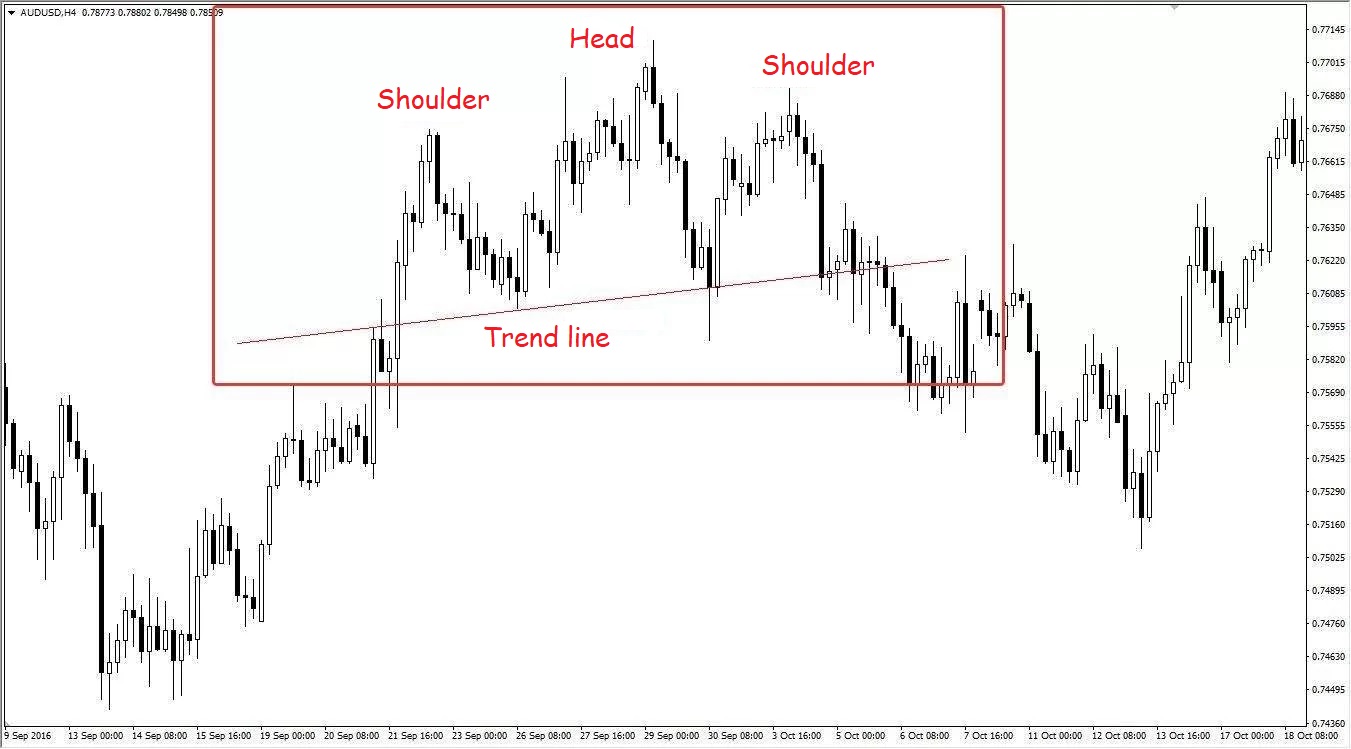
One of the reversal patterns on the chart is head and shoulders. This model has clear rules for construction and identification. However, there are some of its configurations that also indicate a trend reversal.


Reversal patterns of technical analysis

Before changing direction, the prevailing trend in the market will give a signal. This is what the founder of technical analysis, Charles Dow, said. Based on how the price behaves, we can draw a conclusion about what is happening with the balance of power in the market.

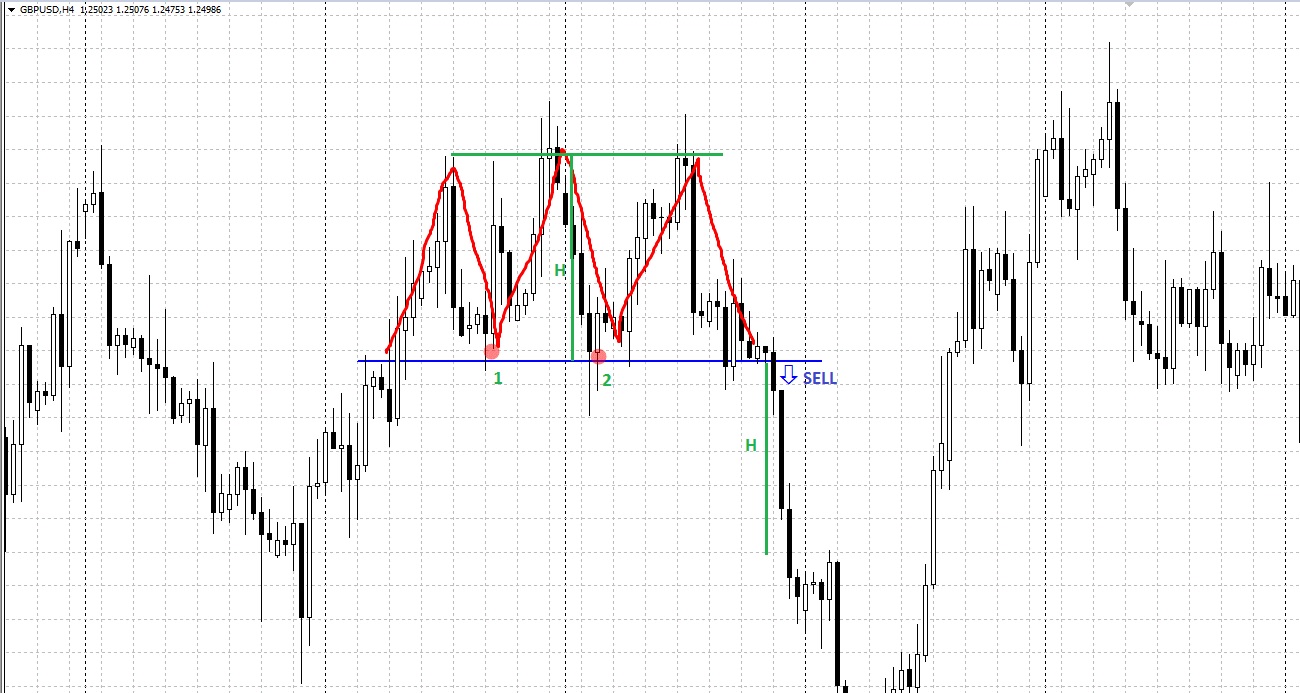
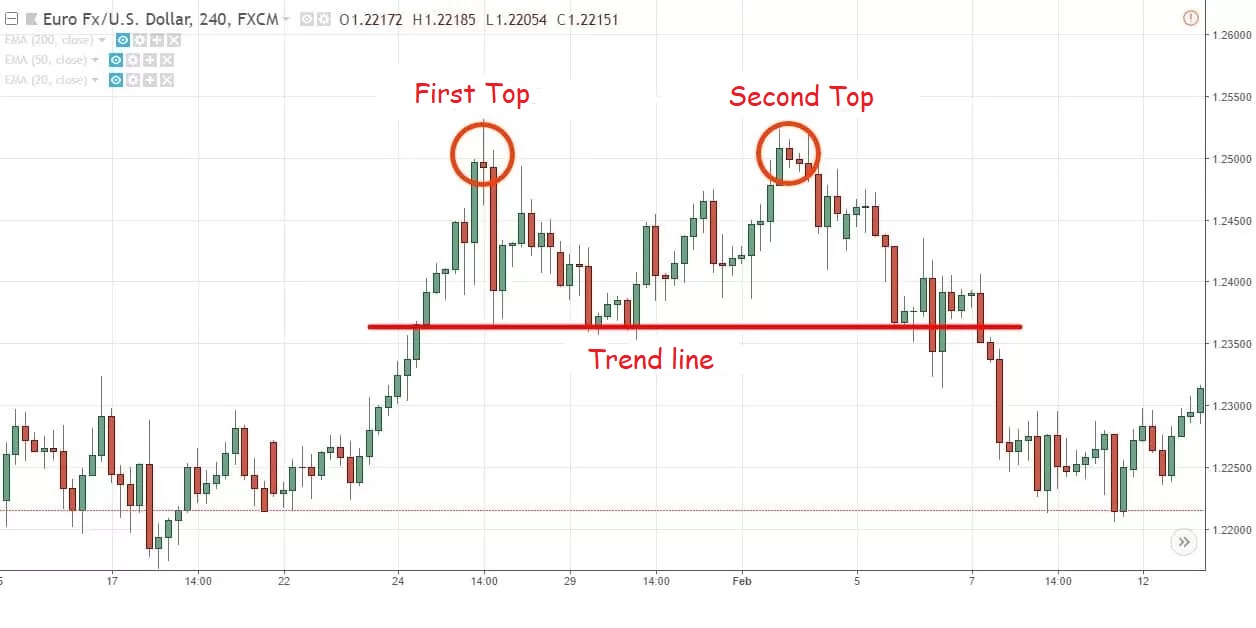
When a trend changes from upward to downward, one of three patterns can be seen on the chart: head and shoulders, double top and triple top. They are sometimes confused by calling double top and double head and shoulders.

Head and shoulders
Head and shoulders


double top
double top


triple top
triple top


To understand why a reversal occurs, you need to know what a head and shoulders pattern means. Price growth in an upward trend is due to the dominance of buyers. After the growth stage, some players take profits, provoking a downward correction. However, in an uptrend, each subsequent low and high are higher than the previous one.

The moment a head and shoulders, double top or triple top (a variation of the head and shoulders pattern) appears on the chart, it becomes clear that the price cannot overcome the previous high. This means that the strength of the bulls is weakening, and dominance is passing to sellers, foreshadowing a break in the trend.


How does the head and shoulders pattern work?

Regardless of whether a double head and shoulders, double or triple top pattern appears on the chart, these patterns trade approximately the same.

First, it is necessary to correctly define the model – it must be preceded by an upward trend. In a downward trend, these figures will be formed in a mirror image: triple and double bottoms, head and shoulders inverted (inverse) will be signals of a change from a downward trend to an upward one.

Secondly, using the lows of the figures formed at the top of the uptrend, it is necessary to draw a neckline. This is the border, upon the breakdown of which a bearish signal is formed.

A sell trade must be placed after the neck line is broken. Already on the next candle after the breakout, which has opened and is forming below the level, you can open a position.

To determine the target and take profit, it is necessary to measure the height of the figure’s head or the overall height of the pattern if we are talking about a double or triple top pattern. It must be moved down from the breakout line and a take profit should be set there.


Automatic trading on the stock exchange

Automated trading opens up opportunities to make money on the stock exchange, ahead of the human factor. In addition, now among large market participants more than 70% of all trading operations are carried out by robots. What automated Forex trading programs are available to private investors?


Features of automatic trading

Manual trading on the stock exchange or forex is available to all private investors. It will bring systematic profit if transactions are concluded not chaotically, but on the basis of one verified income strategy.

Some of these strategies, which do not involve the factor of human intuition when making decisions, can be automated by creating an algorithm that will independently analyze the market, read the trading signal, and open and close Forex trades.

A program for automatic trading on the stock exchange is called a robot or advisor. Their algorithms are built, as a rule, on the basis of mathematical indicators, technical analysis strategies, as well as candlestick patterns, which the program can easily read from the chart.

Robots constantly monitor the market to search for conditions specified in the robot’s algorithm. When these conditions are met, a trade is opened. You can also set parameters for stop loss and take profit, conditions for increasing the volume of positions, and criteria for risk management.
Where can I get a trading robot?

To earn money without manual trading, you need a program for automatic earnings on Forex – a robot or advisor. Where can I get it?

Automate your own strategy. If the trading system is simple and amenable to algorithmization, it can be turned into a robot. To do this, you need to either study programming in MQL yourself, or assign such a task to specialists. A program for automatic trading on Forex will be an excellent solution for those who have worked out the strategy well, are convinced of its profitability, and know how to set the parameters correctly. In addition, this will eliminate emotions and the influence of the human factor.
Download for free or buy a ready-made robot. In this case, scalpers or robots that trade on news are very good advisors. They allow you to overcome the limitation in the speed of placing orders. Multi-currency work, using several strategies to simultaneously analyze a number of currency pairs, would also be a good solution.

Automated trading: benefits and precautions?

Now anyone can trade Forex with the help of robots. But these ways of earning money, along with the benefits, also have pitfalls.

The automatic trading program saves time and removes the limitations of the human factor – the psychological component and limits in speed and reaction. Experienced traders who have automated their strategy continue to monitor its operation, tweak and improve the robot if necessary.

Beginners are often tempted to avoid the need for training and try to replace the ability to analyze the market with a robot. This often works against them, as advisors have their own pitfalls.

Often the algorithms of robots, especially high-yield ones, incorporate Martingale averaging methods or use order grids. This significantly increases the risks and, if the initial lot is set incorrectly or the deposit is small, it can lead to losses.

To prevent this from happening, it is important to understand the algorithm of the program that is used for automatic trading. Before you start working, you need to test the robot on a demo account or cent accounts to ensure profitability and understand the maximum drawdown size.

How to calculate profit factor

Profit factor is one of the most commonly used statistical indicators of the effectiveness of an exchange trading system. The higher the profit factor, the lower the actual risk that a trader faces when working with such a system.

The profit factor is calculated as the ratio of the amount of profit from all transactions to the amount of losses from all transactions. The optimal value is considered to be a value greater than 1.6.

For example, the system brought 6980 points of profit (the sum of all profitable trades) and 1898 points of losses (the sum of all unprofitable trades) during the month. What will be its profit factor?

Divide 6980 by 1898 and get a value of about 3.6. This means that the system is quite stable and can be profitable in the long term. But what’s even more important is that when trading using it, the trader has a small risk of loss. And as you know, for most traders, especially those trading with large capitals, reducing the risk of losses is an even higher priority goal than increasing profits.

Thus, measuring and analyzing the profit factor will allow you to understand how effective the trading system is and whether changes need to be made to reduce the risk that the trader bears when working on it.
Some experts advise not to take into account the most successful trade of the period, or even a number of such trades, when calculating the profit factor. The point here is to reduce the influence of happy accidents and present the profit factor in a more realistic form. In this case, the most unprofitable trade is always taken into account. This approach is practiced precisely because the very idea of analyzing the profit factor is already associated with the desire of an investor or trader to choose for himself options for trading systems with minimal risk.

In addition to the real profit factor (which is calculated based on already completed transactions), you can also calculate the predicted one, which depends on the ratio of the distance to the Stop Loss and Take Profit orders. For example, if the standard distance to TakeProfit, divided by the standard distance to StopLoss, is less than 2, then such a system is likely to be unprofitable in the long term, or extremely unprofitable.

Another important point is the period for which the analysis is carried out. However, it is not so much the period as the number of transactions that is important. Obviously, if there are only 2 transactions, and both are winning, then it will not be possible to calculate the profit factor at all. When there are 10, 20 or more transactions, it becomes possible to see the objective value of the profit factor and draw conclusions about the effectiveness of the system.

Hashrate

The concept of hashrate

All cryptocurrencies use the blockchain principle (a continuous chain of blocks – hence the name), according to which each subsequent block stores information about the previous one. It is this approach that provides networks with stability and security due to the impossibility of interference in the chain from the outside.

Each block is a piece of information packaged in a certain way, for example, about a transaction on the network. The most important part is the unique title. It strictly complies with the rules established on the network and allows you to uniquely identify a block, that is, enter information into the database and then, if necessary, retrieve it.

The header is generated by solving a complex cryptographic problem, during which a given amount of information is converted into a unique set of characters of a given length. This transformation is called hashing, and the resulting set of characters is called a hash. Each cryptocurrency network uses a specific hashing algorithm, which determines the rules for calculating the hash.

It also specifies the acceptable block header format. For example, for the Bitcoin network it might look like this:

0000000000000000002037646f063ea032548c4906a6a2b6e16d7ee90c8ba9bc

To find a header that matches the conditions specified on the network, you need to perform a certain (quite large) number of hashing operations. This is exactly what users’ equipment does when mining cryptocurrencies. The number of such operations per unit of time may vary. This is what is called speed, often hardware performance or hashrate.

Hashrate also has another meaning, which is used as a characteristic of the network as a whole. This indicator reflects the total number of hash calculations per second performed by all equipment included in the network.
How is hashrate measured?

So, hashrate is the number of hashing operations or hash calculations performed by equipment per unit of time. The reference unit of time is 1 second, that is, the hashrate is measured in hashes per second (h/s, H/s). Since the performance of modern equipment is high, and the blockchain networks of almost all cryptocurrencies include millions of pieces of equipment, they often operate in multiples of units:


Unit Console Number of zeros
kH/s Kilo 3 (thousand)
MH/s Mega 6 (million)
GH/s Giga 9 (billion)
TH/s Tera 12 (trillion)
PH/s Peta 15 (quadrillion)
EH/s Exa 18 (quintillion)
ZH/s Zeta 21 (sextillion)

That is, when they talk about kH/s, kilohashes per second (they practically don’t talk about them anymore, since equipment performance has left such numbers far behind), they mean that several thousand hash calculations are performed per second. 2 EH/s means two quintillion (2 followed by 18 zeros) hashes are calculated per second. For example, as of August 20, 2023, the current hashrate of the Bitcoin network was 473.4 EH/s. This figure clearly illustrates what kind of computing power is involved in the extraction of the first cryptocurrency.

Hashrate value for blockchain networks

Hashrate shows how many hashing operations the equipment (whether an individual miner or the network as a whole) performs per unit of time. It is logical to assume that the larger this value, the shorter the time it takes to calculate the correct header (finding a block) in the blockchain network.

From a miner’s point of view, an increase in hashrate is equivalent to an increase in profitability. Indeed, the more often the user’s equipment finds the correct (valid) block, the more often its owner receives a reward. On the Bitcoin network it is currently 6.25 coins per block. After the next halving (halving), which will occur approximately in April 2024, it will decrease to 3.125 coins.

Since the frequency of receiving rewards is directly related to hardware performance (hashrate), miners strive to increase it using various methods. Of course, you can buy tons of equipment and earn a decent income. However, there are several obstacles along this path:

Mining equipment is expensive, so increasing your own capacity is not so easy.
The networks have grown so large, and their hashrate is so high, that an individual user is unlikely to be able to assemble a mining rig with such productivity to obtain an acceptable (which is not calculated in years) probability of finding a block.
If each user increases the computing power of their equipment, the hashrate of the entire network will increase accordingly, which will practically not change the situation for an individual miner.
A good option is to increase performance without changing the network hashrate. This is exactly what miners do when they join together in pools. The total computing power of such a union allows valid blocks to be generated quite often. In this case, the reward is divided between the participants, bringing them income that they do not need to wait for years.

Hashrate and network complexity

Reducing the time it takes to mine a block and pay out rewards is not an absolute advantage from the network’s point of view. On the contrary, in the Bitcoin network, for example, the mining time for the next block is approximately the same – about 10 minutes. To implement such a limitation, some kind of counterbalance to the growth of hashrate is required. This counterbalance was the growing complexity of the network.

Network complexity is usually called the average number of hashing operations required to obtain the next valid block. If this indicator grows at the same rate as the hashrate, the speed of finding a block will remain unchanged. This principle is used in all cryptocurrency networks.

Difficulty adjustment is carried out by changing the type of valid block. In the Bitcoin network, the type of header for which is shown above, the difficulty is changed by adjusting the number of leading zeros in it.

On a note! The complexity of the network is determined not by hashrate measurements, but by the time spent generating a certain number of previous blocks. So, in the Bitcoin network this number is 2016. That is, recalculation is carried out every 2016 blocks, and the difficulty is set so that it takes about two weeks to find the next 2016.

Thus, for a miner, hashrate turns out to be the main indicator. Using it, he selects equipment that will bring (taking into account electricity costs and commissions) the desired profitability. At the same time, the performance of the equipment is its hashrate, and when choosing, its relationship with the overall hashrate of the network and its complexity is taken into account.